
The Creative Process of Rewriting History with Assassin’s Creed
Episode 294
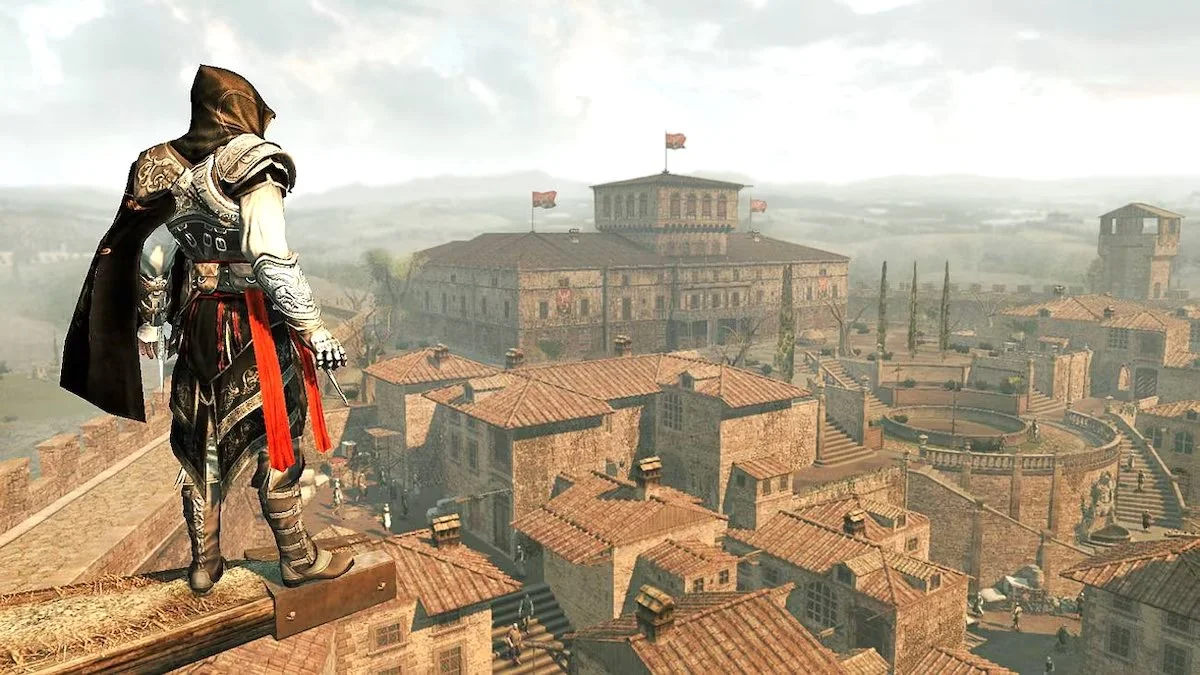
Darby McDevitt is a narrative director and writer at Ubisoft. He’s worked on multiple games in the Assassin’s Creed franchise, which spans time periods from Ancient Greece to Victorian England. But what does it mean to be a writer on a massive video game where your character is mostly running, climbing, jumping and fighting? The key to his work lies in historical research, but he is sometimes torn between what would actually happen and what pop culture has trained us to expect from different eras of history. We also discuss his new novel, The Halter, which imagines a future where virtual reality is so realistic and addictive that people abandon their real lives and have to be tracked down. This is the first episode in a multi-part series on video games. MUSIC LISTTake the Shot by AnterosRapidfire by EvoliBreathe Goods by CargoDaydreamer by Brock HewittInterlude by Clemens Ruh
The Creative Process of Rewriting History with Assassin’s Creed transcriptYou’re listening to Imaginary Worlds, a show about how we create them and why we suspend our disbelief. I’m Eric Molinsky.
At the beginning of the pandemic, when we were in lockdown and no one knew when it would end, I would watch videos of people playing Assassin’s Creed. But they weren’t really playing these video games. They were just moving the characters around to explore the world. It was like virtual sightseeing and time travel at the same time.
The concept of Assassin’s Creed is that there is a device called The Animus, which allows people to tap into the memories of their ancestors and experience their lives as a form of virtual reality.
CLAY: You remember the Animus -- the machine we use to unravel genetic memories and relive the lives of our ancestors? First you were Altaïr, a stoic 12th century Assassin from the Holy Land. Then you were Ezio Auditore, a wealthy Italian with charisma and a talent for revenge.
That’s right, their ancestors are assassins – but they’re not villains. They’re fighting an organization called The Templars, which wants to control the world.
Each of these games take place in a different time period from ancient Greece and ancient Egypt to the French Revolution and Victorian England. And the games have incredible attention to detail. I’ve also watched videos where historians discuss the level of accuracy in the games.
If these games sound ambitious and expensive – they are. The game company Ubisoft has been spending over a hundred million dollars on the more recent full-length games. There are also spin-off games and bonus content. The franchise has earned billions of dollars over the last two decades. And along the way, they’ve relied on the writer Darby McDevitt.
Darby was hired in December of 2008 to work on Assassin’s Creed II. Since then, he’s worked on some of their biggest titles like Assassin’s Creed IV: Black Flag – which is about pirates -- and Assassin’s Creed: Valhalla – which is about Vikings.
Darby also wrote a sci-fi novel about virtual reality called The Halter -- which does not take place in the world of Assassin’s Creed. We’ll talk about that later, but first I had a lot of questions about his day job.
I assumed that as a writer on video games, he mainly wrote the dialogue scenes or “cutscenes” which the player watches between levels of gameplay. But Darby works with a lot of different departments at their studio in Montreal. In fact, the first time I talked with him, he was in the middle of coaching actors on one of their upcoming games.
But the first thing he does when he starts working on a new game is to delve into historical research. I asked him, how long does that process usually take?
DARBY: It depends on how long you have some games. If we, I've only had 10 months to do it. Uh, the current game I'm working on, um, it's been quite a few years, so it depends on how much time you have. But the general process I like to, um, engage with is that I, I just read, which is read. I just read, read, read, read. And there's a certain point at which you start to feel really conversant in the time period when you can just sort of off the top of your head, you can start, you can start listing dates and characters and events, and you can, you can put pieces together and you can, you, you have a general feeling for the period and who the people were and, and what, what motivated them. It's at that point; I think that I start thinking about story. Now, games are made in, in parallel. I'm not doing my work so that other people can do their work. I'm doing my work. At the same time. Artists are researching architecture styles and, and you know, textiles and things like that. And musicians are, our sound designers are researching the music of the time period. And it's all, so there's, there's always a point where all this research comes together in parallel and we start sharing laterally. And a lot of times something I want to do will sort of rub against what say, you know, a, an artist wants to do, even if the, the two, um, the two references that we're both using are similar. What has to win out in the end is the, is the, is how they're used in the game. Because when we were making a, I say an imaginary world for a video game, the number one criteria is how are we going to interact with it? What, how's it going to contribute to the player experience? And that can be quite different than, say, if you were making a film or you're researching a historical novel where the history aspect especially is, is in large part world building and storytelling. But the, the interactivity element adds a really interesting wrinkle because it's possible to add things in the world that, that are alluring and seem like they could be interacted with but cannot. So I'll give an example of, of when we were working on Revelations, um, which is set in Istanbul, Constantinople at the time in the 16th century. And we all went down to E3, the Electronic Entertainment Expo, which is defunct now, but at the time, you know, it's a place where you take your, you take your game, you shot off for journalists. And we were really proud that in, in like eight months, we'd made this recreation of Istanbul just, you know, 70 years or so after the Ottoman, uh, takeover. So it was a, you know, it was a Greek city, a Byzantine city. Now it's a Turkish city. And so it's really vibrant and wild. And, and my friend Kama, she's, she's a, the, uh, she was the animation director. She's demoing the game for an Italian journalist. And this journalist doesn't seem to be to know that much about games. I think he was sent by a newspaper in Italy, and he's really, he's looking at this game with wide eyes. He loves this recreation of, of Istanbul where we're navigating through a little, uh, spice market that's got fish and textiles and, and spices on display. And he just stops and he says, can I, can I eat those spices? And he said, and Kama’s like, which spices? He goes, those ones right there. And in the little, in the little bin next to the guy's, uh, you know, under the guy's tent. And he says, oh, no, no, those are just for display, and then, uh, oh, those fish, can I eat the fish <laugh>? And he says, no, no, no, those are just decoration. And he just, well, what, what can you do in this game? As, as if everything on display was somehow actually there for you to be, uh, you know, to be interacted with. But, but she had to explain to him, no, this is a combat action adventure game. What we do is we kill people and we climb on buildings <laugh> and we hide in haystacks. And that's about it. There's some doors you can open. Um, there are some, let's say, collectibles to pick up <laugh>, but by and large, the world is a gigantic, let's say dead diorama, right? It's there for immersion. I guess that's not to undersell the purpose of immersion, but certainly when the designers are looking at this game and they're saying, you know, we're making this world, but what can you really do in this world?
The other thing is what's satisfying for you as a player? Because, you know, uh, because I, I always read this on message boards and people are always like, why can't I do this? Why can't I do that? Why can't I do that? And it's just like, okay, let's say you can eat the fish. What does that mean? You say you click, you say click this button to eat the fish. Bling! You ate the fish. Yeah. Like, was that really as satisfying as eating a, a piece of fish?
DARBY: Yeah. It has to have some sort of use or purpose in the long run. Like we, there, there's a kind of almost that we could invent in all almost corollary where the more things you can interact with in the world, unless you have a budget of 30 years and $17 billion, right? The more you can interact with the lower the realization of it's going to be, like you just said, it's like you could have an animation where he picks it up, he looks at it, he puts it into his mouth, he chews it, or whatever, right? That would take an enormous amount of programming, art, animation resources. And to what effect, I don't know. There are games that let you do that. There are games like Dwarf Fortress and Rim World, which are deep, deep, deep simulations. Um, Skyrim, Skyrim has a tremendous amount of things you can interact with in the world, but the realization is very, very low, right? When you eat a, let's say a cheese wheel in Skyrim, it just disappears from the world and then your health goes up a little bit, maybe, or you, and it makes a satisfying little crunching noise. And Dwarf Fortress, I don't know if you're familiar with that, but it's a game that's made entirely of ASCII characters.
Of what characters?
DARBY: ASCII, you know, uh, the little, you know, textile characters little, uh, at symbols and oh, and hashtags. It's, it's really low res, but it's, the simulation is incredibly deep. But the, the realization of that is, like I said, you're just reading text. It's not, it's not happening on screen in front of you in a, in a, in a way that, like an Assassin's Creed game would. So there are also, weirdly enough, there's, this is one of my favorite stories of working on Assassin's Creed, Valhalla, which is a game set during the, in the, the Viking invasion of England. So we recreated all of England in the ninth century. Um, so you can, you can ride your horse from London all the way up to York and anywhere or in between and east to west. And so we filled this world with flora and fauna, and one of the things you see a lot of is sheep, because the Anglo-Saxons at the time, they raised a lot of sheep. So, sheep dot the hills everywhere,
SFX SHEEP
EIVOR: Sounds like a sheep, and not a happy one.
SFX: ARROW KILLING SHEEP
DARBY: And you can interact with these sheep and you can kill them. You know, like you can kill most of the, um, animals in the game. Now, I came into work one day and the game director, a guy named Eric, he was puzzling over a problem. The problem was, is that in our game, when you got injured, your health bar went down and you could heal it. You could heal yourself by finding berries on bushes that were scattered around the world. But he was thinking, should there be more ways to do that? Well, so we put in like little pots of food that you can find in camps, and you can eat from that. Great. You get some health back. The problem he was trying to puzzle over was whether or not killing a sheep and looting the mutton would also give your health back, because he realized that there was a perverse incentive in offering this to players, which would be that if players were low on health and they saw a field of 20 sheep <laugh>, they would just, they would just go slaughter all the sheep and, and realistically, in real life, right? That would be possible. If I were wandering around Anglo-Saxon, England, I might want to, and I was, I was hurt and hungry, I might want to kill a sheep. But the ease of which you can do it in our game, which is like a couple ax swings, would, would turn people into basically....
Serial killers <laugh>.
DARBY: Sheep serial killers. So, this is the kind of perverse incentive that you could, if you, if you add the ability to do things in these interactive worlds, not only do you need a use for it, but you also need to make sure that you're not creating a perverse incentive to, to, to abuse it. But these are the kinds of things you have to think about when you create these fictional worlds.
AD BREAK
Earlier, Darby mentioned that when the different departments at the studio are working on games simultaneously, sometimes they realize that they’ve gone in different directions. They have to reconcile their ideas pretty quickly. I asked him to give me an example.
DARBY: One thing that I, one thing that I really remember was in, in Black Flag, there were, um, historically there were, there are two very well recorded instances in the, um, in the Atlantic Ocean. Um, there are more in the Pacific and the Indian Ocean, but in the Atlantic Ocean of, uh, two women who were pirates, Anne Bonny and Mary Read, and they both appear in Black Flag. And there, the story especially about Mary Read was that she disguised herself dressed as a man, so she could fit amongst this company and without being hassled or what, whatever, whatever her motivations were, you know, there's very little about her actually. So, but what we do know is that she, um, she dressed as a man and, and, and, and passed as a man for quite some time. Anne Bonny came into the picture a little later. They apparently sailed together with a guy named Calico Jack. For the story team, we were really like, these women have to look like they're dressing like men, because we, in fact, as part of the story, we want you to be fooled by, by Mary Read, we want you to think maybe she's just a young man that's, we gave her a fake name, James, uh, James Kidd, to be like the, the bastard son of, or of, of Captain Kidd, or who sailed, uh, 10 years earlier. And when we saw the first concept arts, they're like, look at these badass, uh, you know, women pirates. They looked like women. They were very cool looking, but they looked like women. And we said, no, but the story needs them to pass. And, and in fact, we want to fool the audience, hopefully. And, and, okay, we'll make some adjustments. And the adjustments, it, it took a while for those adjustments to really swing it to the other way to make sure that yes, this is, this is plausible. This woman could plausibly walk amongst all these grizzled, bearded men and pass as a man. Because a lot of earlier versions didn't quite live up to it. And it was probably because maybe there was, in the art, in the artist's mind, there was a more stylized thing going like, let's stylize these. Like these are the, these are two women pirates. Let's make sure that the women who are playing, or the people who want to see women in this role, they're interested and they're impressed by this character. There's, there's nothing better sometimes than just great character design in games. Uh, a game where you can get a new outfit and put it on. I'm like, look at, look at how great my character looks. That's a big, it's, it's cosplaying in the digital sphere, and that's important. But at the same time, for our story, it was important that it's worked for the story.
EDWARD: Cheery bunch of mates you've got.
MARY: You deserve scorn, Edward, prancing about like one of us, bringing shame to our cause.
EDWARD: And what is that, your cause?
MARY: To be blunt, we kill people, Templars and their associates, folks who'd like to control all the empires on Earth, claiming it's in the name of peace and order.
EDWARD: Sounds like Ducasse’s dying words.
MARY: You see, it's about power really about lording over people robbing us of liberty.
So have you, um, and I, and I believe that I, I've, I've read or heard this, that, that there are moments that you were interact, you were researching games, uh, researching time periods, and you discovered that there are things about this time period that are historically accurate. But if that's the way the game played out, it would contradict every movie, TV show or novel we have that takes place within this, this time period. Like what are some examples of that?
DARBY: Well, my favorite one is definitely when we are working on a Black Flag, our pirate game, the typical image of a pirate is of a swashbuckling, uh, a sailor with, you know, a bit of grease on the face and maybe a little smelly, but with a brace of guns in a and a and a sword, and that he's firing cannons at, at, uh, ships. And he's swinging aboard and, and sort of fighting and getting the loot that way. It turns out the reality of pirates was much, much less, uh, exciting. The reality of pirates was that they were armed to the teeth, but on very small boats, they would usually drive up alongside, um, merchant ships who didn't have a lot of ways to defend themselves. They would scare them, maybe fire a few shots across the bow, but they would essentially just browbeat them into giving over their stuff. And if the Royal Navy showed up, they would skedaddle because a little tiny, uh, schooner, pirate schooner is no match for a gigantic, you know, galleon or, you know, with 40 gun or 60 guns or whatever. But we thought, what are we going to do? Make a pirate game where you just sail around scaring people? Like, is there a scare meter? Is there, is there a button to make faces or shout? You know, like we actually considered it. We, we tried to brainstorm what, what that could possibly be, but in the end, the fantasy of firing cannons and hear the roar of those cannons and feel the smoke, uh, and, and, you know, swinging to the deck of another ship and having a sword of fight, that that fantasy, the pull of that fantasy is too much. And we, we had to do that. So that's one where we, we really leaned into, into the, the, the myth. You tend to sail around in Black Flag attacking the navy, the British Navy, the Spanish Navy, even the, the, the Portuguese Navy in some cases, because that brings the action level up higher. Again, it's, it all gets back to interactivity. What are you going to ask the player to do?
And also the question of what do we want from an immersive experience? Because part of the appeal of the Assassin's Creed franchise has that going back in time feeling, and yet it's still a fantasy. And so, it sounds like you guys often have to ask yourself, what do people want from this immersive experience? Do you really want, do you want the fantasy of what it would be like to go back in time? Or do we find some happy medium?
DARBY: Yeah. We thought a lot about this on the, the Viking game as well. There is a, um, there was a very short period all things considered with the Roman Empire where they were in England. They, they pulled out because of trouble at home, but for a few hundred years, they, they, they had a foothold in England, and they captured a, a decent part of, of the island on the whole, they didn't leave a lot of ruins. Uh, they didn't leave a lot of, of their footprint, uh, on the island. If you took a trip on by car around England, you wouldn't see much. We wanted to give the feeling of, because our game is set in eight, I think it was eight, uh, 880 AD. So about four or 500 years after the Romans left, we wanted to give players the feeling that they were kind of walking around the footprint of an expired empire, almost post-apocalyptic. So from an art standpoint, we decided that we would exaggerate the Roman ruins, we would put more of them, we would make them larger than life. That way anybody wandering around our landscape would see this sort of like crumbling a aqueduct in the, in the background or a, a crumbling Roman Colosseum in the middle of London. It wasn't really as, as, let's say, magnificent as that. But we had to decide with the limited time that we have our players for, let's say you play our game for 50 to a hundred hours, we really wanted to make sure that you understood that this was a, this was a, this was the dark ages. This is the age where the Roman Empire pulled out. And now there's no written history. There's, there's the technology available to people is, is much reduced. Some historians, when they wander around, say like, there's no, this, this did not happen. There was not this level or this amount of Roman ruins, but we aired on the side of the immersive aspect or the, the immediacy of like, wow, look at that. You know, that's a, that's a bygone age. And then through the writing, we would, sometimes we would have characters say like, do you know these, those aqueducts were built by giants because that's what they actually thought. They, they didn't know who this cult this culture was. It was 400 years later. And they thought, oh, it was a race of giant men and women who built these. Yeah. So we exaggerate strategically, uh, to give you the, the intended effect.
It sounds like, you know, every one of these problems you're, you're talking about from the way you're describing it, it sounds like it was a fairly quick and relatively quick and easy <laugh>, um, solution you came up with. Were there some big challenges, thorny issues with like Valhalla or Black Flag where the creative team really like, struggled to figure out the answer?
DARBY: Yeah, I mean, I won't go too much into it because it, it was a very long discussion, but definitely like figuring out how to treat, uh, slavery in these times. Um, the Vikings were, I mean, everybody I think in the, in the ninth century was, slavery was practiced, um, it was one tribe enslaving another. And we, we, we would talk long and hard about how we, how we depict that and do we, you know, is there a character that that represents that is there a deeper, uh, system involved? And that once you, especially once you get into the idea of systematizing and gamifying something, an institution like slavery, you, you're, you're really, you're like treading on thin ice because there's, there's a lot of wrong ways to do that. So we, we generally, we didn't, we didn't ignore it completely, but we would tend to just put it in narrative. We would have a character who was, uh, represented the, the idea. Um, but we would try to stay away from, from depicting it as a gameplay system. The closest we got was there was a DLC for, um, for a Black Flag called Freedom Cry, which dealt head on with slavery. And that wasn't made by, uh, the studio in Montreal that was made by the studio in Quebec. And, and they, and I know they put a lot of thought into that one.
The term that he mentioned, DLC, is short for downloadable content. It’s like a shorter bonus game. Freedom Cry takes place in what’s now called Haiti, when it was still a French colony. The main character in Freedom Cry was a supporting character in Black Flag.
ADÉWALÉ: Perhaps our needs may align for a time, what do you need?
EDWARD: Recruits, liberated slaves, the warriors among them join me, the others grow the community for which we fight.
ADÉWALÉ: I suppose I might lend a hand for a time.
EDWARD: I will see that you are rewarded for whatever you can give.
AD BREAK
Outside of his job at Ubisoft, Darby also wrote a sci-fi novel called The Halter, which doesn’t take place in the Assassin’s Creed universe. Although his experience working in the game industry had an influence on the novel.
The Halter takes place in a future where virtual reality has become incredibly realistic and addictive. One of the characters believes this technology could be used to close “the empathy gap,” which is a term people use in the real world. I asked Darby, why was that important to the story.
DARBY: Well, I, I needed a character, there’s a character in the book called Delia, who she gets her start working in, in this, in the book, it's called, uh, uh, surrogate reality because it's even more immersive. It sort of takes over your brain rather than you want us to differentiate it between the, the virtual reality we have now, VR. So surrogate reality is shortened to SR. Um, or surreal. Um, in the same way that movies, uh, the, the word movies was coined. I think of Delia in this, in this book, as she's faced with this incredible technology that really absorbs and can almost take over a brain and transport somebody into a complete and total simulation. And she wants to figure out, I can't let this just be escapist. I can't. Because what she says at some point in the book is she's noticing that every, every time a new medium comes, it hijacks another one of our senses. And this is even going to go further. And indeed, like it's a world where people get so addicted to surreality, that there's a whole class of people called Halters who are paid to go in and pull people out. People who are addicted, you know, they might be logged in from a, a storage unit somewhere hiding from their family because all they want to do is stay in this world until maybe their body wastes away. And so halter, go get these people. Well, Delia recognizes this, and she says, the, the only the only use that she can see that's going to avoid this is to try to connect with people on an empathy level and, and how hard it is. And she has some pretty interesting conclusions by the end of it. Not to say that they're correct, but she, she has some conclusions that like, maybe a lot of the assumptions about art and about media and about especially video games, are actually what's hurting us. The idea of giving people agency, maybe agency in some sense is actually preventing empathy, which is a weird thing to say. because we, we, I think everybody values their own agency. But I think, I think if, if you have agency, if you're hearing somebody else's story and you have agency to judge it from whatever angle you'd like to judge it, it's always possible to just dismiss that story for, for whatever reasons.
So a bigot could be forced to experience life as a person from a marginalized group for a period of time. Or someone convicted of fraud could be sentenced to experience the life of someone they cheated.
I told Darby this reminds me of Assassin's Creed because in the game, people use a device to experience the life of one of their ancestors and walk a mile in their shoes -- or run across rooftops in their shoes.
DARBY: Yeah. One of the premises of Assassin's Creed is that you're a person in the present day reliving the life of a historical person, but there's always a remove. In fact, many times in the games you will see the historical character talking, and then you'll actually hear the present day person commenting on what's happening in the, so there's always a, almost a double consciousness in a weird way. Um, but there's definitely this feeling of like going into a, a world and being able to be somebody else or act in a different way because you don't have the constraints of, of the real world to, to, to sort of lock you down anymore. But The Halter, I guess is kind of written as a response to things. I couldn't really explore in Assassin's Creed in terms of simulation.
Hmm. Well, I was going to say, in terms of written as a response, I mean, you know, I feel like art is always in a long conversation with itself. You know, genre is in a long conversation with itself. So there's been, uh, a lot of stories about VR, a lot of sci-fi stories. There's Ready Player One, Neuromancer, The Matrix, Black Mirror, Snow Crash. Were there things that you wanted to do differently that you're like, okay, that's all that, those are all great, but many classics there, but you were like, but, but I'd like to do this. I'd like this to be my statement about what I want to do differently.
DARBY: I, I think it's really just gets down to the, the effect of the technology rather than the promise of it. It's taken as a given in my world that people are going to use VR for entertainment. That they're going to use it to distract themselves and to have fun. And, and that's perfectly legit. And I almost imagine that Ready Player One could happen in my universe, like the whole thing could happen. But what I was really interested in was what's the effect of that long term after 20, 30 years of fully 100% immersive VR, what are the pathologies that pop up? Who gets hurt by it? Um, how does it disrupt things like people's employment, education, um, who gets addicted to it? Even the people who are trying to do something more, I wouldn't say more interesting with it, but let's say like to close the empathy gap. How do they get derailed from that process? Who stands to make lots of money off this? So it was, it was really more like taking as a given. I, I didn't, I didn't want to focus too much on look what virtual reality can do and look how much fun it's going to be. I think there's been enough of that, and I think that's taken as a given. But what are the, what are the knock on effects? What are the, the perverse, uh, what's the blowback? And, and that's where I wanted to situate myself.
Is there a virtual world that you would love to lose yourself in, even if it's a guilty pleasure?
DARBY: Oh, my, oh my. In my novel, there's a brief mention of the, one of the first popular surreal, which was that it allowed you to explore the entire universe by, by increasing your scale. Like you could, you could be a one-to-one me, and then you could grow and you could, you could jump over to Mars and you could grow up. You now, now the planets are basically just basketballs in your hand, and you could grow and grow. Because since a very young age, I'd always been really into astronomy. And I just love, and I remember feeling a, a great, deep, deeply pained by the fact that I can't go visit another planet. That I can't go visit the black hole at the center of the Milky Way that I can't go. I, I think there's something about the universe that I would love to be able to, I would love to be able to, to explore the universe in a way that was as accurate as possible so that I could get some sense of the scale of the place. I'm not somebody who thinks that we're actually going to live on Mars, that's a part of my novel. But the part, the, the parts in the novel in the Halter where the, the main characters dreaming about maybe taking a trip to Mars represents an older version of me that would've liked to have done that. But I don't think it's either possible or feasible or even necessarily a good idea.
That subplot was partly inspired by a certain billionaire who is heavily invested in going to Mars. Darby had also heard arguments that if life becomes unbearable on Earth because of climate change, virtual worlds will be more tempting than ever.
DARBY: And so I wanted to dramatize that, where there is a simulated world on, you know, in the Halter. And there is simultaneously people at the very first steps of colonizing Mars. There's only been a few trips. It's not like there's a, you know, a whole city on Mars. Just the first couple trips have gone. And it's to represent this idea that, okay, we could go either way. What, what if there was a guy like me, he was like the, the, the 10-year-old me. He was like, I would just love to get off the planet and start a new, start a new, because that's the dream that's been sold. But by the end of the book is like, maybe that's a little bit overblown, or maybe that's not actually going to happen.
Well, I keep thinking about, you know, in, in terms of going to Mars, escaping Earth, going to Mars, or the surreal, the problem in both cases. The old saying that no matter where you go there you are <laugh>. It seems like that seems to be the problem in the end.
DARBY: Yeah, yeah, exactly like that. That's you, you, yeah. There's this one theater in my book where a person goes in to it to befriend an identical copy of themselves so that they can try to get this objective sense of themselves. And yet they just, it just devolves into sort of abuse and like, I hate this person <laugh>.
<laugh>.
DARBY: And so yeah, the best laid plans, <laugh>.
There isn’t a single answer as to what we want from an immersive experience. Different people want different things. And sometimes what we want changes depending on what’s going on in our lives. We’ll keep exploring this question in the next episode. But we will scale down from a billion dollar franchise to an indie video game that’s hand drawn.
That’s it for this week. Thank you for listening. Special thanks to Darby McDevitt. His novel, The Halter, will be out in February. My assistant producer is Stephanie Billman.
We have another show called Between Imaginary Worlds. It’s a more casual chat show that is only available to listeners who pledge on Patreon. In the most recent episode, I talked with Richard Bartle. In the 1970s, he was a pioneer of text-based computer games. His computer program was called a multi-user dungeon or MUD for short. And he developed MUD as a reaction against the British class system.
RICHARD: I could see all these friends of mine around me being forced to live lives that fitted other people. They were like liquids being poured into a jar and they had to fit the jar. The idea, or the hope, was that by playing MUD, you could pretend to be somebody else, your character, and through pretending to be somebody else, you would find out who you, yourself really were, and then you could bring that back into the real world with you.
Between Imaginary Worlds comes included with the ad-free version of the show that you can get on Patreon. You can also buy an ad-free subscription on Apple Podcasts.
If you donate to the show on Patreon, at different levels you also get either free Imaginary Worlds stickers, a mug, or a t-shirt, and a link to a Dropbox account, which has the full-length interviews of every guest in every episode. You can subscribe to the show’s newsletter at imaginary worlds podcast dot org.