
Episode 307
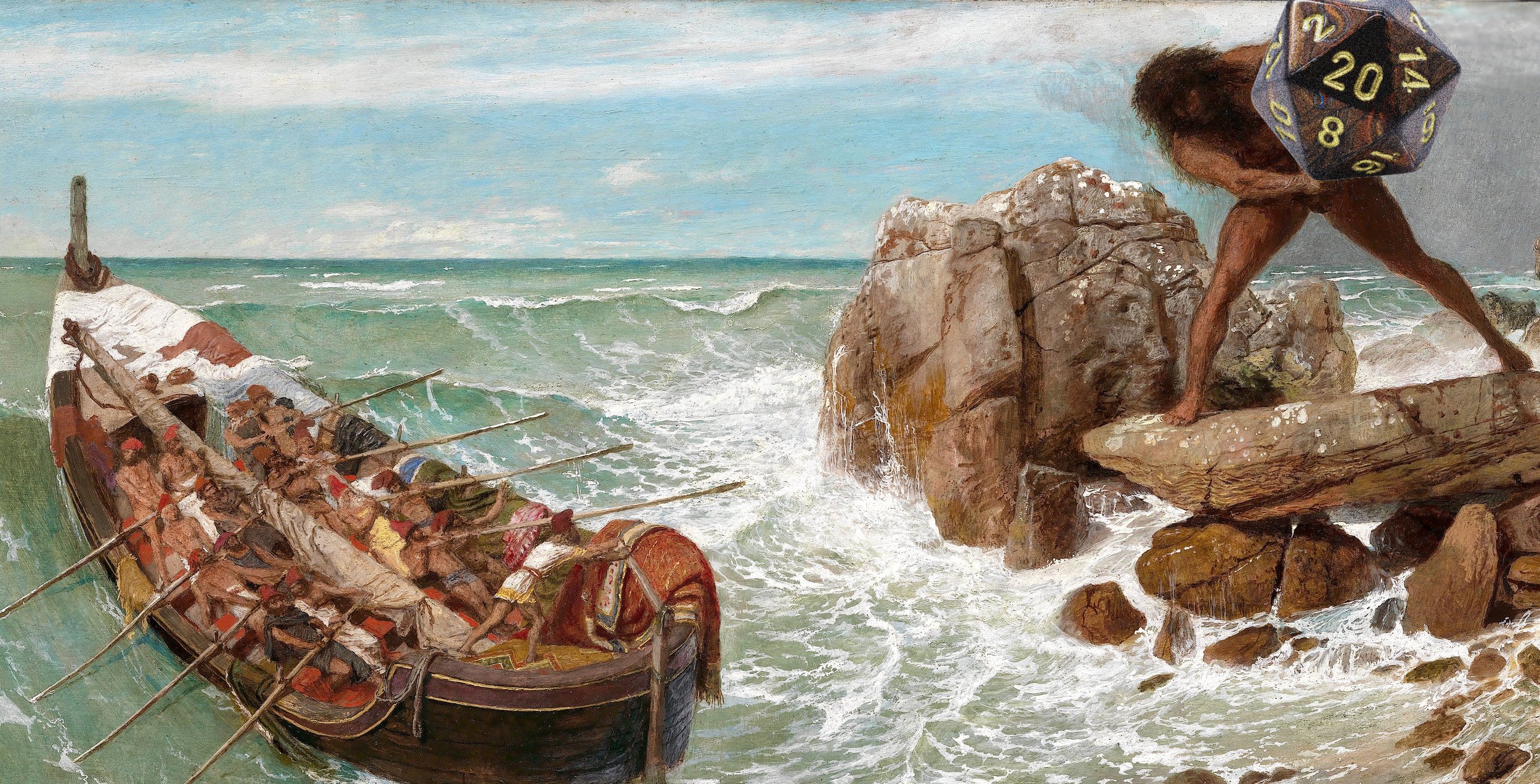
Christopher Nolan’s film The Odyssey is part of a long line of film adaptations, but Homer’s epic poem has quietly shaped another medium: role-playing games. The structure of The Odyssey is practically a blueprint for tabletop and video game RPGs from the ‘boss fights’ with fantasy creatures to the way Odysseus levels up through the tale. Professor Roger Travis explains how ancient bards engaged in a similar type of immersive storytelling as game masters today. Laura Jenkinson-Brown argues that Odysseus’s choices are like a dialogue tree in a choose-your-own-adventure book. That’s why she wrote one called “You Are Odysseus. Plus, John Haygood and Jonathan Drake tell me tell me how they’ve created tabletop role-playing games that tap into Greek mythology and reward players for embracing the values of the Homeric world. MUSIC LISTOpa Opa by Nathan WelchProject Blue Book by Craft CasePlain Intentions by Blue Dot SessionsProject Blue Book by Craft CaseBlowing Bubbles by Cutesy Chamber Ensemble
Choose Your Own Odyssey transcriptYou’re listening to Imaginary Worlds, a show about how we create them and why we suspend our disbelief, I’m Eric Molinsky.
Laura Jenkinson-Brown teaches ancient history at a high school in England. The Odyssey is a big part of her curriculum.
LAURA: I teach it to students who are 15, 16 years old and they love looking at the text and finding ways to be amused by it.
Which is not surprising. Teenagers often think they know more than adults, especially adults in ye olden days. But to be fair, Odysseus is not exactly a role model for today.
LAURA: He's always making choices. He doesn't always make the right choices, or at least not necessarily the choices that we would think of perhaps as right. And he often does things that are questionable and considering that his, his motive in leaving Troy was to get home, he failed somewhat.
By about ten years.
So, Laura started brainstorming how she could get her students into the mindset of Odysseus. And she created a classroom project that was like a choose-your-own adventure book. In fact, she eventually turned it into a book called “You Are Odysseus.”
LAURA: So I would write the original story and let that simmer and then I'd go to this branch and go, right, well what would've happened if he'd done the alternate of this? And so yeah, all of these branches, they then became very big branches and got very twiggy and there were branches upon branches upon branches that could lead to different endings. So in the very end there are 51 different endings including the right one. So there is one perfectly right ending, but there's also lots of variations on the right ending. And there's also lots of variations on other endings. You don't die in all of them. You do die in quite a lot of them though because you would, you would die in these scenarios.
I thought it was interesting that Laura used the analogy of branches because there’s a term called a dialogue tree which is used a lot in role-playing video games. It means every choice that the player makes leads to another branch of the story that a game designer created.
So how did her students do when they tried to make better choices than Odysseus?
LAURA: Mostly they die <laughs> which is funny. Straight away.
They did figure one way to survive. Don’t make The Odyssey like a total odyssey.
LAURA: And what they proved is that they're a lovely caring individual who cares about their men but is also quite a stickler for the rules and then go home, uh, ignore any distractions and get home and have the happily ever after, lovely ending, the type that I wrote where all the characters that you see later on in the original Odyssey are there, but younger and happier what life could have been, which is rather nice. But they immediately apparently then retry it and then they try and do what Odysseus does to see the difference.
You know, you could say too is if they say, I played nice and I got home really quickly and I lived a happy life, say great, uh, unfortunately I've never heard of you
LAURA: Exactly.
Your tale was lost to history. It wasn't even much of a tale.
LAURA: Every time you, you finish in the book and you get to an ending, I give you an epithet or I say how well you will be remembered. And if you get home safe, like you have a lovely happy ending, and absolutely no one remembers you, exactly as you've said because that is the point of it. So if he doesn't do the Odyssey, he's not got anyone singing his praises for the next couple of thousand years because we still read about him, we still make films about him.
Films like The Odyssey, directed by Christopher Nolan.
Clip of The Odyssey trailer.
There is a long history of The Odyssey being adapted into any type of art or media you can think of -- from classical paintings to Hollywood blockbusters. But there is one area that doesn't get as much attention: games. And I have a theory that The Odyssey might be the origin of role playing games.
I mean, tabletop role playing games like D&D are clearly influenced by Tolkien, Lovecraft and other fantasy writers from the 20th century. But The Odyssey set a template.
Also the 20-sided die that is synonymous with D&D is over 2,000 years old. Some of the earliest D20s that archeologists found have Greek letters on them. Although they were probably used for spiritual purposes, not gaming.
Roger Travis is a professor at the University of Connecticut. He studies the Venn diagram where role playing games and Greek mythology overlap.
He says first we have to think about how people in the ancient world would’ve experienced The Odyssey. They would’ve watched professional bards sing the story from memory.
ROGER: Bards recomposed out of the, uh, the narrative systems that lived in their memories and in the memories of their fellow bards and recomposed them into new forms that couldn't be the same version of the story that had come from them the night before and wouldn't be the, the same version that was the night afterwards. The same way, if you play a module of Dungeons & Dragons five times, you're going to have five wildly different experiences.
He says the audience in ancient Greece would already be familiar with the story The Iliad or The Odyssey. What made a bard stand out was the way they remixed the elements and added their own twists. That’s similar to the way a game master creates a story for their players.
ROGER: And a game master knows from their training that is having read the, uh, read the module, um, read the mechanics in, in the big books like the Dungeon Masters Guide, they have the narrative materials to recompose the story on the fly. And then what happens when a gifted game designer, I guess any game designer puts a game, uh, into a piece of software, the mechanics that are coded into that software provide that same possibility space and possibility space is, is a, a term that I find really useful to think with, um, because it exists inside, uh, the code of a video game. It exists in the relationship between a game master and his or her players. And it exists in the imagination of the bard and also the imagination of the bard's audience as they're experiencing it.
Gamers have an expression for that: “the theater of the mind.”
Now I like this analogy, but I told Roger that I have one issue with it. The bard may be reading the room and adjusting the story of the fly -- but the audience is passive. They’re not affecting the outcome of the story based on their verbal choices. Roger said that’s true, but that’s why he thinks:
ROGER: It’s the bard who is the player, so that the bard gets to be both the designer of the game and the game master and the player in this analogy.
There are also narrative elements in this Venn diagram between role-playing games and Homeric epics.
Thematically, a lot of Greek mythology is about fate versus free will. The gods are like game masters in the way they can craft the world. But in a lot of myths, the gods are bound by fate. Trying to change fate is an ordeal. And in a game like D&D, the game masters can play the role of the gods as NPCs -- non-playing characters -- but even they are bound by the roll of the dice. Finding a way around those numbers requires a sacrifice, although using by spending bonus points or using one of your limited spells.
Then there’s the structure of The Odyssey.
Odysseus is part of a wandering party on a quest. They want treasure and glory. They can add loot to their inventory. And the crew encounters supernatural creatures like the Cyclops, the Sirens, Scylla and Charybdis. There are battle mechanics to these monsters. The humans are basically rolling the dice to make sure they don’t die.
Roger says there’s a Greek word for that kind of storytelling: aristeia.
ROGER: And Aristeia just means basically a story of excellence. And in an Aristeia, and we have several of them in the Iliad, um, a given hero will, uh, go through a series of encounters finally ending with a climactic encounter that's like a boss fight.
A boss fight is a term from video games. It’s the antagonist you have to fight when you get to the highest level of a sequence or the whole game.
Laura Jenkinson-Brown also thinks that throughout The Odyssey, Odysseus is leveling up like a character in a game.
LAURA: We start off, we leave Troy, he sacks the Cicones. They are regular human people, although he does an incredibly D&D thing, which is where he allows the priest of Apollo to live and thus gets in return the super strength wine that no one else knows about that you must mix only one, uh, one part wine to 20 parts of water because it's so strong. Plot point needed later. And then the second episode gets slightly more supernatural. They're kind of blown off course. They get to the island of the Lotus Eaters and the Lotus Eaters don't really speak. So they're human, but they don't communicate. And instead all they do is offer the lotus and they eat the lotus and they stop wanting to do anything. So he wrenches these men who've eaten the lotus back to the ship for their own good. And then we get to episode three where we are firmly rooted in the supernatural and they end up having the experience with the cyclops, which is devastating. He loses six men, all eaten by the cyclops and he's got to try and find his way out of the cave. This is where the special wine comes in. He needs that he wouldn't have been able to drug the cyclops without such strong wine.
When the cyclops falls asleep, Odysseus blinds him.
LAURA: And then his cleverest moment there, which is the moment that people really pick up on, is when he pretends his name is nobody. So that then when the cyclops is blinded and he shouts out, “nobody is blinding me,” none of the other cyclops come to his aid.
Odysseus makes mistakes as well — the kinds of things her students got annoyed with.
When Odysseus is sailing away, he taunts the cyclops, thinking there’s nothing the cyclops can do now. He can't see Odysseys, but he can hear him and he throws a boulder in his direction.
What happens next in The Odyssey practically plays out like a D&D game. I can imagine a game master saying, “Okay, let’s roll for the cyclops.” He gets a high number but not the highest.
So the GM says, “The boulder flies through the air, you think it’s going to hit your ship. It comes really close and lands in the water, but the splash is so huge, it creates a wave that sends you all the way back to shore. What do you do?”
Then I can imagine the person playing Odysseus says, “I try to get back on the sea.”
The GM says, “Give me a strength check,” meaning let’s see how strong you are.
Odysseus rolls very high. The GM says, “You did it. You summoned all your strength and turned the boat around just as you were reaching the shore. Now you’re totally in the clear.”
LAURA: And they get further, a little bit further out this time. And he leans over and starts shouting again. And this time we are told, he tells us, even his men are telling him, shut up. What are you doing? He's almost killed us once. And this time he makes an even bigger mistake. He tells the cyclops his real name, and now having told the cyclops his name, he is able to be cursed by the cyclops.
Odysseus had been away for 10 years fighting in the Trojan War. The curse of the cyclops prevents him from getting home for another 10 years.
LAURA: But the reason why he has to tell the cyclops his name is, if he doesn't, he's never going to get the kudos for having blinded the cyclops, which kind of works because it is the first thing people remember really about the Odyssey is the whole scene with the cyclops. It's the most enduring scene, I think, and the one that people immediately go to. So it's mistakes like that which do have a reason behind them. They're technically unnecessary. He didn't need to do all of that. He could have, he could have possibly been home by this point, but in a way he does need to do it because that's who Odysseus is. And that's what the culture is at this time for these heroes. They're not necessarily likable people like now, heroes now are people who do the right thing and do it for good and save others. Ancient Greek heroes aren't really like that. They're just really amazingly skilled, probably because of divine heritage. And then they don't always do likable things. What they do is memorable things.
And so I'm imagining telling an ancient Greek hero with great power comes great responsibility. And they look at you like, you're crazy <laugh>.
LAURA: I'm responsible to me <laugh>, I have to bring home stuff to warrant having been away for 10 years.
But for Odysseus, what matters in the end is not the amount of loot he has in his inventory.
If this was D&D and you’re looking at his character sheet, he would have numbers for different traits like charisma, wisdom, intelligence, constitution. Some are strengths, some are weaknesses.
But as he gains more experience, even bad experiences, Odysseys would be earning points that he uses to modify his skills to make them even stronger.
LAURA: In a way, he kind of levels down and then levels up again because he's, he's made the mistakes. He consistently loses men. So if you're keeping a tally, if you've got your character sheet right, add money, add money, lose men. I do play a lot of role playing games. You get to the point where he, he loses literally everything and is stuck on the island of Calypso, the island of, um, a year for, for seven years. And then when he leaves, he is washed up on the shore of the Phaeacians literally with nothing. He does not even have clothes on his back. He hasn't got any of the spoils of war. He does not even have clothing. What he has got is experience. So I suppose if you could, if you talk about leveling up as being the experience you've gained, he's maybe, maybe he does level up at that point because he's reached God-level storytelling. Perhaps all a hundred points have been put into this area and he tells a story that no normal bard could ever have told in one night. And because he tells such a good story, the fires literally replace everything that he's lost all his clothes, all his goods, and then they keep adding goods to the pile because he keeps impressing them.
So far, I’ve been talking about the Odyssey as a theoretical role-playing game. But there are people creating RPGs based on The Odyssey. And when I learned how they were gamifying Homeric epics, it made me see The Odyssey in a whole new way.
AD BREAK
One of the game designers I talked with is John Haygood. He’s Greek, and he lives in Athens. The game he’s developing is called Land of Myth. It’s based on The Odyssey but you’re not playing Odysseus.
JOHN: I have never been a fan of playing the, the heroes. The player has to follow their own path, you know, and be free and feel free to do that. Because the moment you, you, you put the, the tag on or the name, there is a constriction. There's a confinement on how you feel things should be and how things should happen.
The players in his game are given archetypes to choose from.
JOHN: So you have the divine offspring who would be, uh, Achilles or Sarpedon who have one divine parent. You have the unrivaled warrior who are basically the majority of the, of the characters that you, the great heroes that you see in the world, like, uh, Ajax or, uh, Hector. These are all unrivaled warriors. I mean, these are people who can step in the battlefield, and they are a one man army. And then you have tricksters, we almost have only one, which is Odysseus himself and seers.
Seers act as a bridge between gods and mortals.
Now, I also talked with Jonathan Drake. He runs TV production companies in the UK. In his spare time, he’s been developing a tabletop role-playing game based on The Odyssey -- and it’s similar to John’s game in that you’re not following the plot of The Odyssey.
Jonathan says back in the time of Homer, there were tales of other heroes who were trying to come home after The Trojan War. The premise of his game is that you’re playing one of those other guys – not Odysseys.
JONATHAN: Because he's just one of hundreds of heroes who are trying to get back from a war.
You know, I forgot to ask you, what is the name of your game?
JONATHAN: Well, you know what I started calling it Nostoi. And then as we say in Britain, I realized I was disappearing up my own ass
<laugh>
JONATHAN: with a, with a word that, uh, frankly, most people are going to. Yeah, I don’t know what that means. So my, my title now is Odyssey. I believe it's pretty public domain because I think it's been out there for a very long time.
Instead of The Odyssey. It's an odyssey.
JONATHAN: It's just Odyssey. Yeah.
And he made interesting choices in how to gamify his Odyssey.
JONATHAN: Essentially all of the heroes have a relationship with the gods and one of the things they do with their treasure is suspend it, sacrificing stuff to the gods to gain divine favor. So again, that's a game mechanism. Wealth in the game. There's no coinage, it's all measured in oxen. If you actually have the oxen, you can take them along and sacrifice them to the gods and you will gain divine favor. There's a mechanism for that.
And the world in his game reflects the way Odysseus would’ve understood his world, or worlds because in myths like The Odyssey, there’s the known world and the unknown world.
JONATHAN: You know, this is when he meets the Cyclops and Scylla and Charybdis and things like that. He's in the unknown world. He doesn't really know where he is, and he is not going to be able to navigate home unless a God or somebody helps him. In the known world is when he talks about going to Egypt or to Crete or to uh, or to Troy, of course, to the land of the Coconas and Thrace where he goes and does more raiding. But the unknown world is where you get bounced around by the gods and fate and the dice.
But when he put the iconic monsters from The Odyssey into his game, he realized:
JONATHAN: Your characters can't kill them. They're, they're just too big, too powerful, and they are immortal. You know, in the end, how you deal with that situation is a role playing question, not a mechanics dice result question. But when it comes to cyclops, yes. I think the only problem I had in designing the game is actually that the number of, let's say creatures or monsters in Greek mythologies is quite limited, and most of them are unique. So there is only one Chimera, there is only one Sphynx.
So he added more monsters from other Greek myths. He also used a different gaming system than D&D. D&D relies heavily on a 20-sided die or a D20.
Jonathan’s game system relies on a 100-sided die -- which is impressive because a D-100 is the size of a golf ball with tiny little sides. But he said they usually just use dice that add up to 100.
Another difference is that the game mechanics in D&D make it tempting to kill first and ask questions later. That’s why there’s a joke that your party of D&D heroes are basically a group of “murder hobos.”
JONATHAN: I think the murder hobos connection is a really good one. You know, the line that goes with that is, we're going to go to, we're going to go kill things and take, take their stuff. And that's exactly what a Greek hero does. When you think of these Greek heroes, I think the best way to imagine them if you don't feel like you know, or you're not familiar with sort of Greek legend myth and history, is they're Vikings in the sunshine. That's, that's the easiest thing to, we've got boat full of guys. We're going to go and get stuff, see what we can do, and if we arrive somewhere where they look like they're tougher than us, we'll go make friends. And if we arrive somewhere, they look weaker than us, we'll kill them and take their stuff, and it's expected of them, and it, it actually brings them glory, the thing they're looking for. But what they also know is they are mortal. Their job is their fate is they're going to die and they want to die well. The other difference between a D100 game and D&D for example, is in D&D your guy gets more powerfully. He has more hit points, better armor, better magic, whatever it is. In D100 games, that doesn't tend to happen. You know, you are just as likely to get run through with a spear or a sword by a bog standard soldier who makes a lucky role and you're dead. And so the more times you throw yourself into danger, the more likely it is you're going to die. You have to make the choices in a more careful way.
John Haygood, the game designer in Greece we heard from earlier, also discovered that D&D was not the best gaming system to base his game off of. Eventually, John switched to a different gaming system called Powered by The Apocalypse or PBTA for short.
I talked about PBTA in an episode from 2021 called Re-Rolling Role-Playing Games. It all started with a tabletop role playing game called Apocalypse World. In that game, your choice of characters were archetypes from different post-apocalyptic stories, and the actions your characters take were specific to that genre. Game designers realized that the system could be adapted to any type of story and any type of genre. That’s why they call that gaming system Powered by The Apocalypse.
JOHN: Generally in PBTA games, there's a very strict adherence to the rules of, of, of not just the fan, the fantasy world that you play in, but to the real, the real world that you come from. You expect people to behave in the same way that you would, would \expect people to behave in this world. This is this general realism in a sense. So of course you can do whatever you like, absolutely, but there are the consequences there always. Actually, the, the importance of the rule set, and this is why shifting from a D&D kind of rule set it into something like PBTA is important, is because the characters will do whatever the game rewards. In games like PBTA, the solution is to, uh, reward other behaviors. And of course, when it comes to combat, you do combat.
But not too much combat because your character might die before they’ve earned enough of value points -- values that were important to Homer and his audience.
JOHN: These are the Kleos, Ponos, Nostos, and Timê, these are, I actually have this in the game as, as actual, uh, attributes on your, on your playbook, on your character sheet. The way I have structured the game. These are the ways, the pathways for your character to progress. Okay? So Kleos means, um, fame, undying fame, glory. Ponos in modern Greek that is, uh, means pain. But, uh, in the Homeric context, it refers to suffering and sacrifice that you have to go through or do. And then Nostos is the homecoming and your desire to return home. And this is basically the, the core theme of the Odyssey is, uh, is Nostos, you know, Odysseus’s struggle to manage to get back home. And then you have, Timê, which translates as honor, but it has absolutely no connection to the honor we understand, which is very medieval, medieval, and of course Christian, because the honor of the Homeric world is one of your peers, which means the other heroes and warriors who are on the same level as you are, recognizing your value and awarding you, basically loot or gifts. And a step further from that is the, the great importance of gift exchange. You know, how people will treat you and whether they will give you the gifts and the loot, and they will share with you and how much they'll share with you reflects your honor, which is basically your standing within this society.
By the way, Laura Jenkinson-Brown did the same thing with her choose-your-own adventure book. The reader is rewarded for following those ancient Greek values. Jonathan Drake did the same thing with his role-playing game.
JONATHAN: So if your character just like a, a hero in the stories arrive somewhere where they're taken in and fed and clothed and given gifts, there's a bond, a permanent bond formed out of that. You owe them something back. If they then say, can you do this for me? Well, the answer has to be yes. Every character will have a rating for certain values, their love of Themis -- divine order or piety -- or their respect for Xenia, for hospitality and the rules of guest friendship. Those are places where you can actually put a score on a sheet and give them the opportunity to test that. If the players sort of going in the direction their character wouldn't.
So of course, your players are not, um, 3000 or 2000 years old, <laugh>, um, they’re modern day people. Have they adjusted to that pretty well? Or are there times that you're just like, oh my God, guys, you're acting like modern people here. This is not what a Greek hero would do.
JONATHAN: Hmm. Um, on my players, I've not had that too much. I've got one in particular who is also a bit of a classicist and just sort of revels in being as ancient as possible about the way they do things.
Oh. How does that play out?
JONATHAN: Uh, that plays really well because, uh, the more I feed that sort of sense of living in this different ancient myth, epic world, then the more fun it's for them. You know, another is, is not that at all. Um, he's a sort of enthusiastic gamer, interested in history, but that's not his thing. But actually I think as long as you continue to remember a few things, first of all, it's going's about having fun. It's not about some kind of lesson in living in different ages. It's about making sure, absorbing those elements as organic within the game. Like you tell a guy, okay, you've got a ship, you've got 30 guys on the ship, and here's what they'll do for you. Here's, here's what they won't. You know, these are not robotic soldier followers who are going to follow your orders. These are people who expect you to behave a certain way to make you deserve their loyalty.
Yeah. I mean, have they ever made choices that surprised you?
JONATHAN: Well, yeah, right off the bat. My, the first run through the first landing they made, they never left. So <laugh>, they're supposed to be heading home, but actually, oh, this is quite nice. We'll, we'll stay here and then we'll set up a kingdom and we'll do this. And, and that kind of threw me a bit but actually we just expanded it, it worked really well, we sandboxed it. It’s all good.
Sandboxing means if the players don’t want to go anywhere – they can stay and keep developing their fenced-in world, their sandbox. But Jonathan is still the game master. He can bring the drama right to their doorstep.
AD BREAK
John Haygood is facing a different challenge in playtesting. He told me that in Greece, combat games and strategy games are popular. The people he’s playtesting with aren’t familiar with narrative games.
JOHN: And even though I've been playing with some of these people for years and they are enjoying the game, it's challenging to move away from it, you know, and be more creative on your own and change the, the story. People here in Greece, because you do, when you're in Greece, you, you do Homer at school. You have a certain feeling about what happened in the story. And, uh, they're finding it difficult to step away from that and create their own story. And I think this is, this is something that I, I'm kind of certain, if I can be certain that is not going to be an issue when the game is played by people abroad.
Well, I’m from another country. I’m very comfortable with narrative games. In fact, prefer them over strategy games or combat games. I asked if I could try playing his game, Land of Myth. He said, sure.
We did a 40-minute playtest. If we were playing a full game, what we did would’ve been a side quiet in a much longer epic. But this gave me a taste of what his game is like
First I had to choose an archetype for my character. I chose a trickster because I wanted to see if I could come close to playing Odysseus. I also chose Athena as my patron. And I used a random name generator to choose a name for my character, and I got Admetos.
But once I started playing Admetos, my character was nothing like Odysseys. I didn’t even play him as a trickster; he was strangely very earnest. And John even gave me the option of coming from Ithaca -- like Odysseys.
JOHN: Or you could come from Athens, which, uh, is a very, you know, uh, one of the most busy route I would expect between Mycenae.
All right. Let's just pick Athens. I'm a city guy. I like my, uh, I like my morning, uh, bagel and coffee in Athens.
JOHN: <laugh>
Apparently, I’m living in a Flintstones version of New York City.
John starts every new game with a scene on Mount Olympus.
JOHN: So basically for a second, you put aside your character and we, you and any other players that we might have, uh, we, we kind of, uh, have a quick look on Olympus and see in what mood are the gods today.
I decided the gods were not in a good mood. They were feuding. Aphrodite was angry with Athena because one of her protegees was disrespectful towards Aphrodite.
But Athena wasn’t having it. She was like, I’m his patron, not his mother. I can’t keep track of all these guys that pledge their allegiance to me.
And then we cut to me in my Athens home. John tells me that night, I have a vivid dream of the temple of Athena in a faraway city.
JOHN: How would you treat that dream?
Uh, I would, uh, is it unusual for me to have a dream like this?
JOHN: Yes, it is. So clear.
Then I would definitely, I would, then I would definitely treat it as a sign from the Gods, but I'm, I'm not sure it means, I think, I assume it means I have to go there.
JOHN: Excellent. That sounds good to me.
When I finally get there, I visit the shop of a person that I know, a stone cutter who used to work with my father.
JOHN: Will you share your dream with him?
Uh, as far as why I am there?
JOHN: As to why you're there? Yes.
Yeah. because I'm kind of cocky, and I’m like I don’t know if you know this, but my patron is Athena, and, uh, so Athena told me to come here, so that's why I'm here. Uh, you know, God, I'm on a mission of the gods, so yeah. I'm kind of about, I don’t know if you've heard of me. I've had some exploits. <laugh>
JOHN: Well, I've heard, I've heard from your father. I had news from your father, and I've, I've heard of, uh, of your exploits...
I don’t know why my character was so cocky.
The man explains to me that Aphrodite cursed the land with a lion which is three times the size of a normal lion. It’s terrifying everyone.
So I go around town to see what else I can learn and I run into a young woman that I knew when I was a kid.
I had to roll the dice -- or John rolled it for me -- to figure out if I have enough charisma to convince her to give me more information.
JOHN: That's a nine and plus two, eleven. So you have a full success. So what would you like them to tell you?
Well, I ask her, does she know why Aphrodite is upset? Who offended Aphrodite?
JOHN: Uh, her brother. It was her brother. They don't know exactly what he did. He won't confess, but it was her brother. Ah. And, uh, she, thankfully, not hopefully, thankfully, she, he hasn't actually killed anyone, but he definitely, uh, behaved in a very inappropriate manner in the temple of, uh, Aphrodite.
Uh oh. I'm, I'm now concerned that I'm going to have to, like, I hope that I don't have to like, kill her brother or something to make things right.
JOHN: No, no. Probably we're going to be, we'll, we'll be able to solve it, uh, in a, in a, in an easier way.
Okay great.
JOHN: <laughs>
Thankfully I did not have to kill the younger brother of my childhood friend -- no Greek tragedies today.
In fact, I learned after a while that the best way to end the curse was to kill the lion and bring its skin to the temple of Aphrodite.
The teenage kid, the younger brother of the woman I knew growing up, was pretty freaked that this was all his fault. So I decided to bring him along with me for back up, and I thought that might please Aphrodite.
JOHN: Do you have a spear? What kind of weapon are you, are you carrying?
Uh, good question. Um, I, I think I have a bow. I'm not the spearing type.
JOHN: Excellent. Uh, so he grabs a bow.
We go find the lion in his den. I climb a tree for leverage. I shoot first. The lion comes charging after me. In his fury, the lion doesn’t see the teenage kid to his side. So I guess that was my trickster move. The kid fires the kill shot, and we bring the skin to the temple of Aphrodite.
John told me that I earned Kleos -- glory -- and timê, honor. I also built trust, Xenia, with the family of my childhood friend, and they would’ve bestowed me with gifts.
JOHN: Excellent. And that's how it ends.
Cool. It's funny, I was expecting to use a lot more charm, but I guess that just this, this one in particular didn't, or, or more trickster-y stuff, but that's fine. I mean it's, uh, you know, I ended up being just kind of a bold, brash young dude. <laugh>.
JOHN: Yeah, exactly. Which is, you know, I mean this is the funny, this is the, the, the fun of the part you, the situation. Like you chose to play it that way and it worked out that way and it's really nice. And what I found really interesting is that even at the end, you didn't choose to be the one who actually shoots the, the, the killing blow. You chose to be the one who actually put yourself, uh, use yourself as a bait to draw out the lion.
Oh yeah.
JOHN: And allow the other, I didn't expect that from you to be honest. I expected you to use the, the, the, the young guys as, uh, as bait and, uh, take the, take the shot yourself.
Oh, you're right. That was kind of stupid. I really put a lot of trust in him. <laugh>
It made sense at the time. My character is older and stronger. It’s the right thing to put myself in danger. And I empowered my new sidekick. Then I realized, I wasn’t thinking like an ancient Greek hero, I was thinking like a Marvel hero.
In role-playing games, I usually make choices just based on gut instincts. And I do something similar in real life, although I’m also reflecting more and seeing what aligns with my personal values.
But learning about these projects made me wonder which of my values are timeless -- you know, part of the human condition -- and which ones are very specific to my time and culture. I thought I had a clear idea but
I’m not sure anymore.
Trying to bridge the gap in understanding people thousands of years ago and thousands of miles away might be one of the most challenging odysseys to undertake.
That’s it for this week. Thank you for listening. Special thanks to John Haygood, Jonathan Drake, Laura Jenkinson-Brown and Roger Travis. My assistant producer is Stephanie Billman.
If you liked this episode, let people know about it on social media or in social situations when someone asks you for podcast recommendations.
We have another show called Between Imaginary Worlds. It’s a more casual chat show that’s only available to listeners who pledge on Patreon. In the most recent episode, I talked with Malcolm Craig. He’s an expert on tabletop role-playing games from The Cold War where the players imagined how they would survive in a post-apocalyptic world. And some of these games from the ‘80s were a big influence on Fallout -- the video game series that was adapted into a show for Amazon.
Between Imaginary Worlds comes included with the ad-free version of the show that you can get on Patreon. You can also buy an ad-free subscription on Apple Podcasts.
If you donate to the show on Patreon, you’ll get access to a Dropbox account, which has the full-length interviews of every guest in every episode. I’ve also selected 25 of my favorite full-length interviews from that Dropbox account and curated them into folders on Patreon.
You can subscribe to the show’s newsletter at imaginary worlds podcast dot org.