
Episode 298
Gene Roddenberry’s name is synonymous with Star Trek, but he relied on a team to bring his vision to life. Most of his writers were men with one exception, the trailblazing Dorothy Fontana. Professionally, she went by D.C. Fontana to counter the belief that women couldn’t write genres like war, Westerns or sci-fi. Fontana became story editor and wrote some of the most beloved episodes of The Original Series, became the de facto showrunner on The Animated Series, and helped launch The Next Generation. She excelled at building character relationships and alien species – especially Vulcans – and worked closely with Leonard Nimoy to develop Spock. I talk with writers and podcasters Jarrah Hodge, Ian Spelling, Brian Drew and Laurie Ulster about how Fontana quietly shaped a franchise and influenced generations of fans through Star Trek’s 60th anniversary. Special thanks to The Writers Guild Foundation Archive for clips of D.C. Fontana from their series, The Writer Speaks. This episode is sponsored by Mizzen + Main. Our listeners get 20% off their first purchase at mizzenandmain.com using the promo code IMAGINARY20. MUSIC LISTLooking for Something byWonders of Nature by Roger GabaldaPacific Time by
How D.C. Fontana Helped Star Trek Live Long and Prosper transcriptYou’re listening to Imaginary Worlds, a show about how we create them and why we suspend our disbelief, I’m Eric Molinsky.
For a while, we got used to the idea that groundbreaking films or TV shows were created by singular geniuses: George Lucas and Star Wars, Stan Lee and Marvel Comics, or Gene Roddenberry and Star Trek. Over time, fans have come to realize that these creators relied on a lot of talented people who made huge contributions to the point where those worlds wouldn’t have been the same without them.
When it comes to Star Trek: The Original Series, there is one particular writer that fans have been praising for years: Dorothy Fontana. Professionally, she went by D.C. Fontana.
Jarrah Hodge is a blogger and podcaster who covers Star Trek.
JARRAH: She was a trailblazer for women in Hollywood. She also was involved in the Women's Committee of The Writer's Guild trying to support more women writers. She was a writing professor, so bringing up The Next Generation of writers,
No pun intended,
JARRAH: <laugh>. Yeah.
Oh yeah, D.C. Fontana was also involved in the creation of Star Trek: The Next Generation. Ian Spelling is another journalist who covers Star Trek. He interviewed Fontana years ago. I asked him, what was she like?
IAN: Interesting, smart, tough! She didn't suffer fools lightly. Uh, you know, she, she was a woman in a time, uh, when there weren't a lot of female writers. And, uh, when she died, there still weren't a lot of female writers. And when she was in between, there were never a lot of female writers.
Laurie Ulster is also a journalist who covers Star Trek.
LAURIE: She was a pioneer man, because women weren't writing particularly women, women who wrote in TV or in entertainment in that day were doing comedies and soaps. She was very interested in action adventure. That was her thing.
Laurie says Dorothy Fontana wanted to be a writer since she was a kid. She moved to Los Angeles after college, and she got a job in the secretarial pool. That was an easy way to get one foot in the door, and Dorothy took advantage of it.
LAURIE: That's how she learned everything. She was reading scripts, she was reading everything that crossed her desk and going in and exploring and seeing how every, seeing how shows were made -- sets, scoring stages and edits so that she knew all about production and she knew who all the agents were. But she told everyone she was a writer, everyone, so that they knew that that's where her aspirations were. Just in terms of the name thing, like it was when she tried to submit, uh, stories to a show called Combat, and she was a big military history buff, and she knew a lot about that stuff, but because her name was Dorothy, they would not even read them. So that's why she changed to D.C. And she was like, they'll read it and then later if they find out I'm a woman, that's their call.
In the 1960s, she was working as a secretary for a producer on a show called The Lieutenant. The man who created that show was Gene Roddenberry.
LAURIE: And Gene's secretary had appendicitis, <laugh> and was out for a bunch of time. And Dorothy moved into that role just temporarily and then went back to hers. But during that time, Gene learned that she was reading the scripts that she was typing and she was paying attention and she had a lot of good ideas.
This is Dorothy Fontana from an interview with The Writer’s Guild in 2012. She said Roddenberry gave her the script for the pilot of Star Trek because he wanted her opinion. She said:
DOROTHY: I liked that Vulcan first officer, and I said, when I brought the pages back, I said, I really like this, uh, who's going to play Spock? And Gene slid a picture across the desk at me of Leonard Nimoy, who had been a guest star on The Lieutenant. And I said, I know the guy. It's fine. You know, that's wonderful.
Dorothy started working on Star Trek as a secretary, but she also wrote scripts herself. At one point they needed to hire a new story editor. A story editor oversees the other writers and helps to guide the creative direction of the show.
DOROTHY: And Gene Roddenberry turned to me and said, okay, I'm going to give you a rewrite. If you can rewrite this script to my satisfaction and to NBC’s satisfaction, you can be my story editor. Because as always, you've been there from the beginning, and you know the show. And that was the big rewrite in that, uh, particular script that sold everybody that I could be the story editor on Star Trek. And I started the next week.
I talked with Laurie Ulster and Brian Drew at the same time, since they both appear on podcasts for Trek Movie dot com. Brian says the brain trust for Star Trek was pretty small. It was Gene Roddenberry, two other men and Dorothy -- who was 27 years old when she became story editor.
BRIAN: If you go through the old memos, the four of them would just bounce ideas back and forth, “Oh this isn't, this isn't really Star Trek, this isn't quite work”. You know, like, and Dorothy's voice was equal with the other three. Like everybody was just bouncing ideas back and forth, you know, that. And that was probably pretty rare.
Does that speak well about Roddenberry in terms of his sense of his character as a person? That he empowered her and she felt that, and it sounds like she, it was, it was a writer's room where she didn't face a lot of sexism.
LAURIE: I don't think she did in that, in this setting.
BRIAN: I mean for all, for all of Gene's reputation with women. He did not apparently have any issues with Dorothy whatsoever.
LAURIE: I think he treated her with respect and knew that she was really vital to Star Trek.
Ian Spelling says it’s great that she was treated as just another writer on the show. The downside is the writers weren’t always happy with how they were treated.
IAN: She was one of the writers and she did the job, and I think he got a lot of the credit for the work that other people did. Like a lot of writers, she bristled at that. Particularly over time, as you know, Star Trek became this phenomenon and, you know, he got all the credit.
If that’s the case, where can we see her influence on the show? When you’re watching an episode written by D.C. Fontana, where do you see Dorothy in that script?
The first Original Series script she’s got a credit for is called Charlie X. The crew discovers a teenaged boy on a planet. He’s emotionally unstable. And he has a superpower. He can manifest things with his mind – whether it’s turning a crew member into an iguana, or forcing Spock to recite poetry.
SPOCK: Once Upon a midnight jury, while I pondered weak and weary.
CHARLIE: Very nice Mr. Ears. Oh, I can make him do anything. Whirl around, laugh. Anything.
KIRK: That's enough. Charlie,
CHARLIE: Don't you think he's funny? I think he's funny.
KIRK: Leave my crew alone.
Laurie Ulster.
LAURIE: In that one, like you can look at it as like, oh, it's a story about this crazy kid and he was given superpowers and, but it's, it's a story about an orphan and it's a story about loneliness and being a teenager and being confused and not knowing how to handle it. And the end could have been written as a win when they get rid of him and instead it's a tragedy.
In the end, the alien race that gave Charlie his powers takes him back.
CHARLIE: Don’t let them take me. I can't even touch them. I can't feel -- not like you. They don't love!
D.C. Fontana was good at establishing lore, whether it was about The Federation or different alien species. But she was always focused on the human elements, even if the characters weren’t human.
Brain says you can really see those themes in her writing when she was asked to rewrite someone else’s script.
BRIAN: Dorothy rewrote an episode from the second season called The Ultimate Computer. Now The Ultimate Computer at its core is basically another trope from The Original Series of a computer running amuck and taking over The Enterprise and causing a lot of problems. But that's not really what that episode's about. It's not what makes that episode interesting. What's interesting about that episode is the struggle that that machine causes two people, Jim Kirk and Richard Daystrom as well.
Richard Draystrom is the name of the scientist who creates the computer.
DAYSTROM: The computer can do your job and without all that.
KIRK: You'll have to prove that to me, doctor.
DAYSTROM: That is what we are here for, isn't it, Captain?
BRIAN: Like Daystrom could have easily been a cartoon character that was just this, you know, scientist that doesn't see what the downside of his technology is. But when it turns out that Richard Daystrom is very motivated for very personal reasons, to prove himself as being something more than like a one hit wonder. And I think that is Dorothy's greatest calling card as a writer was her gift with character.
COMPUTER: Programming includes protection against attack. Enemy vessels must be neutralized,
DAYSTROM: But these are not enemy vessels. These are Federation Starships. You are killing -- we are killing, murdering human beings. Beings of our own kind.
AD BREAK
Jarrah Hodge says Dorothy didn’t just rely on her imagination to bring out a sense of humanity in the characters.
JARRAH: She said that between the first and second seasons, she took the show bible around and she talked to all of the actors and she said, you know, you've lived as this character for a year. What have you learned? What has challenged you? What do, you know, what would you like changed? And she got a lot of really helpful feedback that then she wrote into the bible with Gene’s blessing. But one thing was she wanted to give McCoy a son, and DeForest Kelly said, how about actually we make it a daughter? She thought that was really interesting. It wasn't what she initially assumed because DeForest Kelly being like a Southern gentleman type that she thought, oh, that's interesting. That wasn't what I would have like stereotypically expected.
Brain says the actor she worked with the most was Leonard Nimoy.
BRIAN: I mean, there is, outside of Leonard Nimoy, there is no one on planet Earth that knows Spock better than Dorothy Fontana. She just had a, an affinity for that character and his struggle.
A lot of what they established about Spock and Vulcan culture was picked up in later forms of Star Trek, where other actors played Spock and his parents, Sarek – who is Vulcan -- and Amanda – who is human.
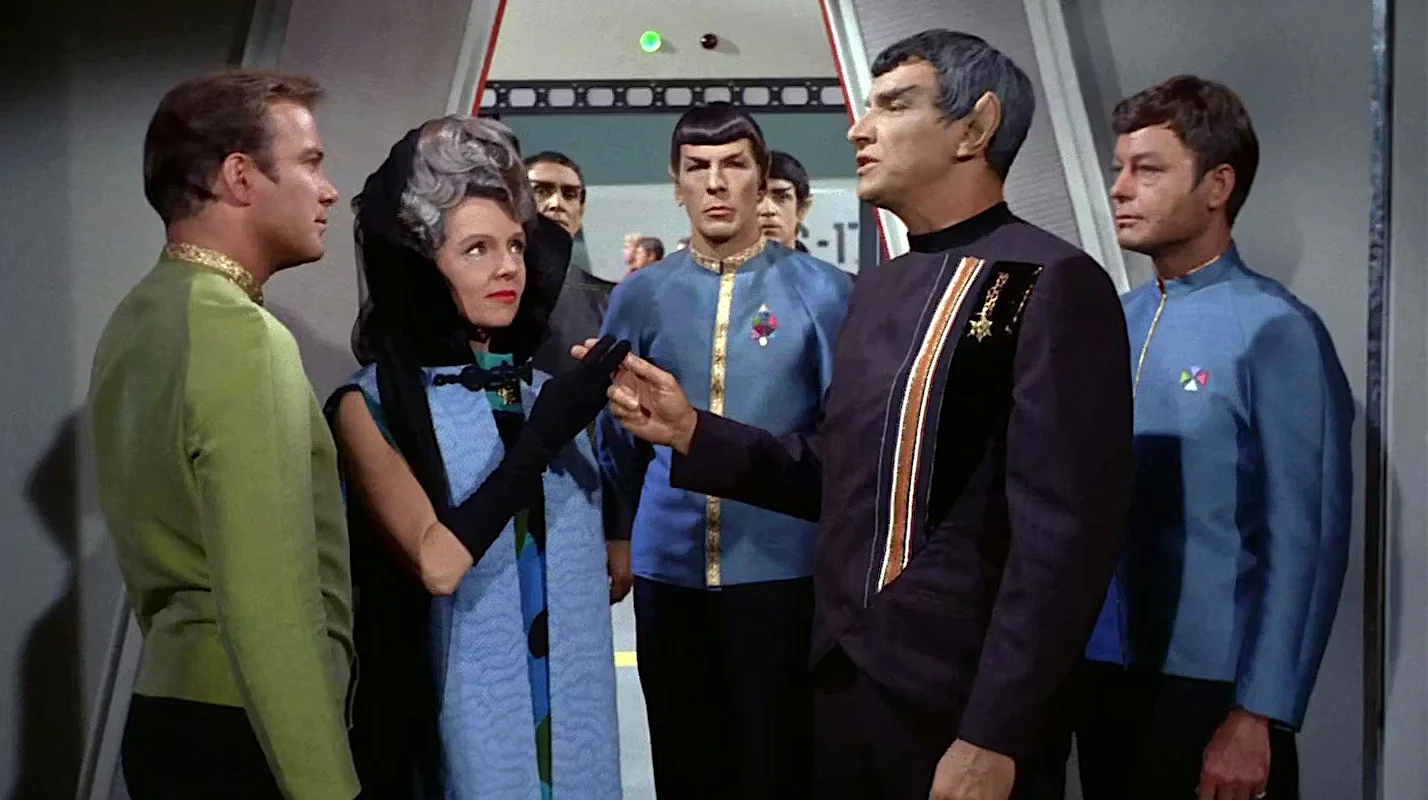
Spock’s parents were first seen in an episode that Dorothy wrote called Journey to Babel. Spock’s father is a Vulcan ambassador.
KIRK: Soon as you're settled, I'll arrange a tour of the ship. Mr. Spock will conduct you.
SARK: I prefer another guide, Captain.
KIRK: As you wish Ambassador.
Again, here’s Jarrah Hodge.
JARRAH: Sarek, Spock's father is pretty icy with Spock because Spock spurned his, what his father saw as his duty to go to the Vulcan Science Academy, and instead he went to Starfleet. And then when Sarek’s life is in danger, the only option is that Spock has to do a risky medical thing to try to save him, but at the same time, there's a situation happening on the ship. And so Spock is torn between his duty to the ship and his duty to his father. His mother, Amanda has this scene where she talks about how, you know, you were tormented.
AMANDA: When you were five years old and came home stiff lipped, anguished because the other boys tormented you saying that you weren't really Vulcan. I watched you, knowing that inside the human part of you was crying and I cried too.
JARRAH: That emotion is so powerful, and you do not see that in some of the, even the more like serious drama scripts that D.C. Fontana didn't write or like didn't concept because she's so focused on where's the family relationships, where is the love in this story? And she talks about love being her theme, not just like romantic love, but family love, and love between friends and can like pinpoint the places in those episodes where she incorporated some of those pieces because of how obvious the emotion and the love is in that moment.
Star Trek became famous for using science fiction to discuss political and social issues. But Laurie says Dorothy would use sci-fi as a metaphor to talk about personal and emotional issues. For instance, the way she described that episode where Sarek disapproved that Spock had joined the Federation:
LAURIE: She said it was a story about the generation gap, which was the expression they used at the time. But she said that's what it's about. It's about parents not getting along and not understanding their child. Like that simple.
D.C. Fontana also wrote a script called This Side of Paradise. The crew lands on a planet where there are flowers which spray spores that make people feel uninhibited. Jarrah says the story was originally pitched by another writer who imagined Sulu would be affected. Dorothy argued it had to be Spock.
JARRAH: And also on this planet, there happens to be Leila Kalomi, who is, has, has been in love with him as former acquaintance of his. He hasn't been able to freely experience love, and he is happy. And, and the reason that it's so successful compared to the original concept is that it's not a shock to see Sulu telling someone he loves them because that's not part of his character that he can't do it.
SPOCK: I love you. I can love you.
But Spock returns to being Spock as we know him. Brain Drew:
BRIAN: There's a great, uh, scene near the end of this Side of Paradise that Dorothy, it's one of my favorite scenes in the series. And because it, it encapsulates Spock very well when Layla Kalomi is, comes on the Enterprise after Spock's been freed the spores, and he tells her, you know, that he has a responsibility to then on the bridge and he says, I am what I am Layla.
SPOCK: And if there are self-made purgatories and we all have to live in them, mine be no worse than someone else's.
LAYLA: I have lost you, haven’t I?
BRIAN: That to me is Spock's struggle right there. Like he, he knows what his lot in life is, at least at that point in his life, how he saw himself as having to live within a box.
Um, I did see an interview with her where she said she thought it was or heard interview where she thought it was fascinating – fascinating to use a Leonard Nimoy eyebrow raise -- that a lot of women were writing the show saying that they found Spock to be a sex symbol, you know, I'm sure did not make William Shatner happy.
LAURIE: No, but it made Leonard Nemo happy. <laugh>
<laugh>
LAURIE: Yes. The, there was a huge thing about Spock being hot. Hot Spock.
There was a rivalry between Shatner and Nimoy at the time about who was the real star of the show. But of course the actors and the characters eventually became great friends. According to Laurie, Dorothy saw the potential in that friendship from the beginning.
LAURIE: I was noticing in my recent binge that every time Spock is in any kind of, every time one of them is in any kind of danger. The other one has the reaction of a spouse. It’s a different level of agitation and concern and worry, even though Kirk feels grief when something happens to anyone and when McCoy is in danger or whatever. But there is something about that friendship that is in every episode.
Jarrah thinks that Dorothy’s interest in complicated family dynamics, and found families, came from her own childhood.
JARRAH: Her father left their, her family when she was quite young, and she had two younger brothers and her mom worked full time and she took, basically took care of her younger brothers while her mom was at work. So, for example, in The Original Series, episode Charlie X, it didn't work out exactly like she intended it, but she did talk about how she thought about her brothers when she was writing that, you know, when you talk about like the alienation of Spock from his father, having that situation where, you know, she also didn't have her father around growing up and he, uh, he left the family and went and, uh, he was having an affair and then started another family. Uh, he did buy them a TV though, and then they basically never talked again, but they were watching all these shows that were on and, uh, particularly Westerns and so she started telling stories with herself and her friends all in them. So I think it was that combination of telling stories and experiencing the joy of consuming stories but also being aware enough of the fact that this is why the story is so compelling, is that it speaks to something that people are experiencing and then being able to draw in from her own experience, the importance of love and family and connection and how it can be beautiful but also messy and heartbreaking.
Laurie says there’s another episode from The Original Series which was personal to Dorothy. It was called Friday’s Child.
LAURIE: In Friday's Child, which was heavily rewritten and she wasn't happy with the ending, but she, as someone who chose not to have kids, and so she wanted to write this female character who Julie Newmar played as someone who, a woman who was so ruthless that she also didn't care, she wasn't interested in being a mother and she didn't care about her child and that's why she wasn't happy about the end where she kind of comes around and, and likes the child because she wanted her to be, she wanted to say there are women who, who aren't mothers.
MCCOY: Say to yourself the child is mine, the child is mind, it is mine.
ELEEN: It’s yours
MCCOY: No , no you got it all wrong.
ELEEN: No, McCoy. It’s yours.
AD BREAK
In the 1970s, Star Trek came back to TV – sort of. Roddenberry was able to get an animated series made with most of the original writers and actors. It’s widely acknowledged that D.C. Fontana was running the show. She didn’t have a background in animation, and the show has that cheap style of 1970s cartoons, but the actors and writers took it very seriously.
Everyone I talked with mentioned an episode she wrote for The Animated Series called Yesteryear. Spock goes back in time and ends up befriending himself as a child. Adult Spock tells everyone that he’s a long lost cousin.
If you remember in Journey to Babel, Spock’s mother talked about the time Spock was taunted as a child. We get to see that scene – and so does Spock. He sees younger self getting bullied.
BOY #1: Earther! Barbarian! Emotional Earther!
BOY #2: You could never be a true Vulcan!
YOUNG SPOCK: That is not true, my father…
BOY #1: Your father brought shame to Vulcan! He married a human!
The climax of the episode is the death of Spock’s childhood pet. It’s a creature called a sehlat, which looks like a saber-toothed bear. His name is I-Chaya. But the death of I-Chaya was not supposed to happen. Spock accidentally altered his timeline by showing up in his own past, and he has to mentor himself through this loss.
JARRAH: And it is another one that will make you cry, bring Kleenex. And it's another one that tells us a bunch of stuff about Spock and about Vulcan that continues to live in his canon today. But it is really another great example of taking the audience seriously and finding another way to connect with their feelings and to show another form of love, which in this case is Spock’s love for his pet.
YOUNG SPOCK: I wanted only to help I-Chaya. He was my father's before he was mine, to lose him...
SPOCK: A Vulcan would face such a loss without tears.
YOUNG SPOCK: How?
SPOCK: By understanding every life comes to an end when time demands it. Loss of life is to be mourned. But only if the life was wasted. I-Chaya’s was not.
Ian Spelling.
IAN: I still cry at that one. Uh, it's just an absolutely beautiful origin story. It's an absolutely beautiful father son type of story. It's got one of these Star Trek creatures that they humanize beautifully and it's so in keeping with what we saw in the 1960s and with what a little bits of what happened in the J.J. movies at the very beginning when we kind of got that little bit of the younger Spock there.
He's talking about the 2009 Star Trek reboot movie.
This is your 35th attempt to elicit an emotional response from me.
You’re neither human nor Vulcan and therefore have no place in this universe.
Look, his human eyes. They look sad, don’t they?
Perhaps an emotional response requires physical stimuli.
<pushing>
The show Strange New Worlds, which is a prequel to The Original Series, also referenced that episode about Spock’s childhood pet.
Now, D.C. Fontana didn’t just write Star Trek. She wrote for a lot of popular shows at the time like Bonanza, The Six Million Dollar Man, The Waltons, and Dallas.
In the 1980s, Gene Roddenberry asked Dorothy to work with him on Star Trek: The Next Generation. She wrote the pilot episode and fleshed out the backstories of the characters and their relationships – although her script was rewritten by Roddenberry.
Ian says her experience of The Next Generation was nothing like the Original Series because Roddenberry was in a different state of mind. He was bitter because he had lost control of the Star Trek movies.
IAN: Roddenberry wanted control. Again, remember, this is a man who had created Star Trek, became kind of a god among the fans. When Star Trek The Motion Picture came out and did just fine by the way. It nevertheless had that taint on it, that it was a very troubled production, and that fell on Roddenberry. So he tried to reinvent the wheel by building out the same wheel he had originally. I think time caught up with him. I think the entertainment business caught up with him. And I think Star Trek: The Next Generation became so unwieldy. It, it was, it was a mess.
Jarrah says there were other issues with Roddenberry as well.
JARRAH: He was aging and not in great health. So he arranged for his lawyer, Leonard Maizlish, to be around the set. And even though he didn't really have a key role, he basically spent a lot of time according to the people that were working there, about making everyone else's enemy. And so, he would, like, review the scripts, he would take credit for things that weren't his. D.C. Fontana said that the last straw for her was when she caught Leonard Maizlish rifling through her desk, uh, one night. Um, but that overall, it was just a really toxic atmosphere and I think that that did sour her relationship with Gene. I don't know whether there was a specific interaction, but just that fact that this man was being trusted to be the caretaker of Gene's legacy and then kind of putting these people that Gene had previously worked respectfully with, putting them in the cross hairs, and then almost all those people ended up leaving. Um, and it left a really sour taste in people’s mouths.
I asked everyone I interviewed if she and Roddenberry ever reconciled before he died in 1991. Nobody knew the answer. She lived until 2019 and never stopped working in that universe.
She co-wrote an episode of the series, Deep Space Nine, which fleshed out a major character’s backstory and solidified details about an alien race called The Trill, which ended up becoming one of the main alien species in the franchise.
She wrote for Star Trek video games, a comic book and a novel called Vulcan’s Glory, which was about Spock. She judged a Star Trek fanfiction contest and even wrote a script for a fan-made production of Star Trek. I talked about that in my 2020 episode about amateur fan films.
Brian and Laurie said her relationship with fans was a huge part of her legacy.
BRIAN: She was involved in fanzines the early fanzines while the show was on the air. She was interacting with the fans and the fan community through fanzines. And then when the conventions became a thing, Dorothy was a, a major presence at those, those early ‘70s, early to mid ‘70s conventions. Dorothy was a major, major part of that.
And this was a time, by the way, when I, a lot the idea of being a Trekkie was a pop culture joke. Like, if you were a Trekkie, if you were going to these conventions, you were the butt of a joke that everybody who's anyway not a loser is going to laugh at. And it sounds like she was just, um, absolutely like, nope, these are our even well after the show ended, she, she sounds like she had a lot of respect for the fans.
LAURIE: Yeah, I think she did. And I think that that is an attitude that has stuck with Star Trek, you know, for all these years that I think they've realized. I think there was a time even after that where it was super uncool and people did try to distance themselves, but she never did. And now you see people, now everybody who comes into the franchise understands like, you got to embrace this because it's going to be a beautiful thing in your life. And look, I went into TV because of Star Trek and the Mary Tyler Moore show, but it was, I was a TV producer for a long time, but I was reading those books, The Making of Star Trek, The World of Star Trek, those things that were like, this is how they make TV, which I didn't see other books at the time. And she's in those books for sure.
Whenever I talk with fans of The Original Series, I’m always amazed that they sound like they have a PhD in Star Trek. They can practically tell you what everyone had for lunch on the set on a particular day in 1967. So they know what Dorothy contributed. Ian thinks one of the reasons why she gave so much love back to the fans was because they respected her first and foremost as a writer.
IAN: She loved the fans because if she walked down the street, most people wouldn't recognize her. But Star Trek fans might, and that is not at a Star Trek convention that was, would be out on the street. I think that even non Star Trek fans are aware of Spock. I mean, she helped create a character and a, a species, for lack of a better phrase, that people talk about 60 years later as if it's a member of the family. I think she knew when she passed away that I would say, you know, D.C. Fontana, Star Trek writer. She was very proud of that. She was very proud of, uh, giving real life to Spock and to Starfleet and The Federation and all of that. I know she was, I mean, that much, she, she told me. My guess would be like any writer; you don't want to get pigeonholed. You don't want to be associated with one thing forever. On the other hand, there are a lot worse things to be associated with, and I think she knew that, and she, I'm, my guess is she'd be the first to say she wishes she got to do more. Uh, I'd be the first to say, I wish we could have seen even more work from her.
Star Trek is celebrating its 60th anniversary this year. Although it’s kind of an awkward year for a celebration. The future of the franchise is in doubt. No one knows what Star Trek movies or TV shows will be happening in the future, and fans have been debating whether the recent movies and TV shows have betrayed or honored Gene Roddenberry’s vision.
Every version of Star Trek looks to previous versions for inspiration. But instead of callbacks and references, I like it when Star Trek uses D.C. Fontana's approach of treating sci-fi as a metaphor to explore relatable human issues. Sometimes the best way to boldly go where no one has gone before is to keep one foot firmly planted on the ground.
That’s it for this week. Thank you for listening. Special thanks to Laurie Ulster, Brian Drew, Jarrah Hodge and Ian Spelling. My assistant producer is Stephanie Billman.
If you liked this episode, text it to a friend, share it on social media or leave a nice review wherever you get your podcasts. There is no shortage of previous episodes you can listen to that cover Star Trek. But you might particularly enjoy two very early episodes of mine called The Cannon and Why Ron Moore Killed Captain Kirk. In 2018, I interviewed the creator of the Klingon language for an episode called Do You Speak Conlang? And in 2022, I interviewed two of the writers on the show Strange New Worlds.
We have another show called Between Imaginary Worlds. It’s a more casual chat show that is only available to listeners who pledge on Patreon. Between Imaginary Worlds comes included with the ad-free version of the show that you can get on Patreon. You can also buy an ad-free subscription on Apple Podcasts.
If you donate to the show on Patreon, at different levels you also get either free Imaginary Worlds stickers, a mug, or a t-shirt, and a link to a Dropbox account, which has the full-length interviews of every guest in every episode.
Our merchandise is also available to buy at our TeePublic store. It’s a great way to support the show and we have really cool designs. I actually have the stickers on my laptop, the t-shirts, the mugs and an Imaginary Worlds pillow that was designed by one of my listeners in Australia. We have a sale going on through March 14th. Just click the link in the show notes or on the website.
You can also subscribe to the show’s newsletter at imaginary worlds podcast dot org.