
Stephen King and the Horror of the Ordinary
Episode 313
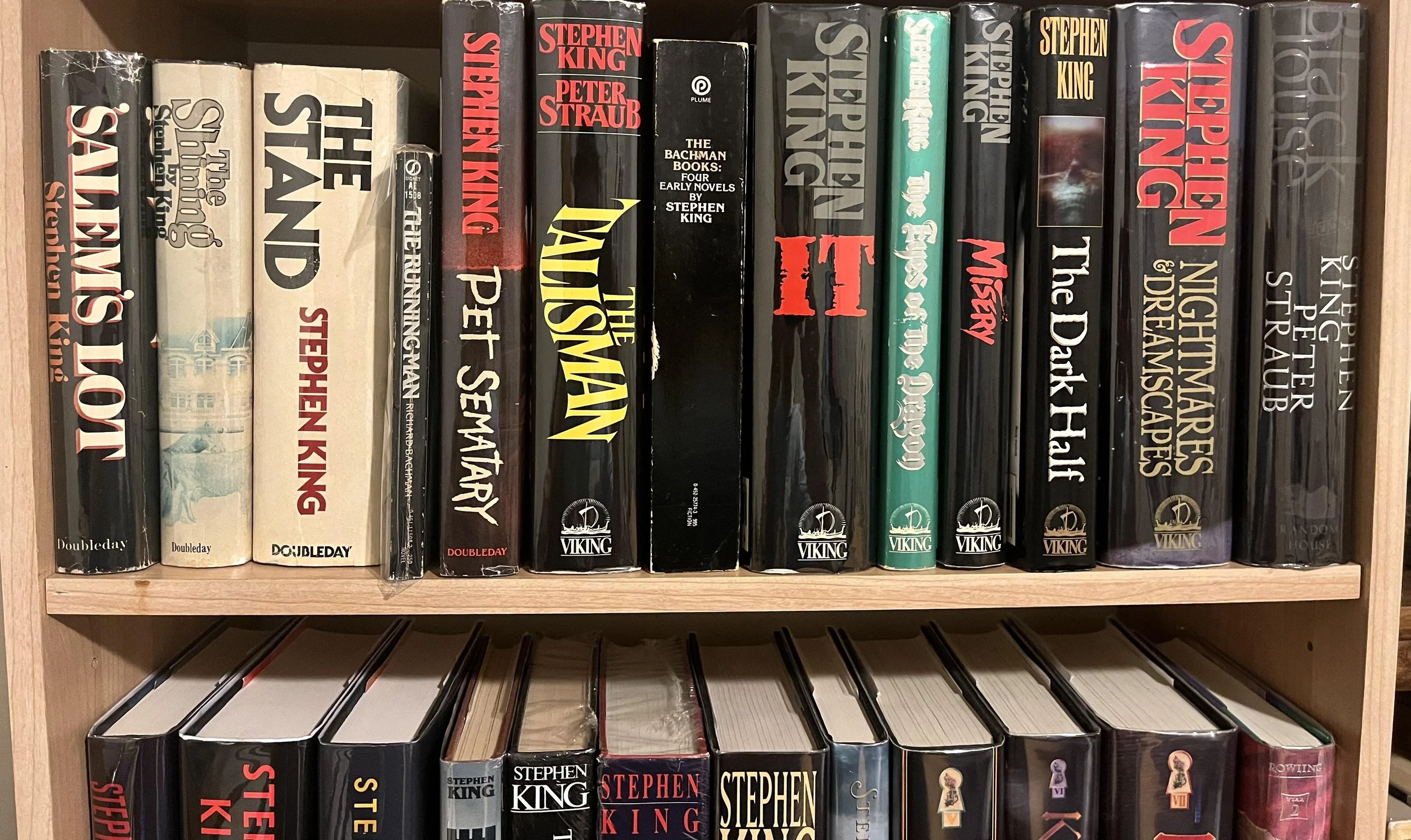
Stephen King is often described as a master of horror, but I talked with fans and experts who believe that King is not actually a horror writer. Caroline Bicks (author of “Monsters in the Archives: My Year of Fear with Stephen King”), Neil McRobert of the podcast Talking Scared and Kim C. of the podcast The Year of Underrated Stephen King discuss the essential ingredients in his stories besides the scares, from the psychological demons of his characters to the isolation of living in a small town. We also explore how King meticulously crafts language, why so many film adaptations have missed the mark, and his impact on pop culture.MUSIC LISTRoadside Bunkhouse by Blue Dot SessionsVik Fence Haflak by Blue Dot SessionsThe Investigator by Dream CaveImaginary Sunset by Alexis CuadradoGreylakes by Blue Dot Sessions
You’re listening to Imaginary Worlds, a show about how we create them and why we suspend our disbelief. I’m Eric Molinsky.
Neil McRobert is the host of a podcast about horror fiction called Talking Scared. He is a huge Stephen King fan. He was really excited when Stephen King agreed to be a guest on the show. He actually came on the show twice, and then Stephen King and Neil started emailing each other.
NEIL: I don't like to outstay my welcome. I get very self-conscious when I email him because I think I don't want to be that guy, but every, so he'll just, he'll just drop me a little missive with some like little horror anecdote or, uh, sometimes a little he'll send me a story that's in, that's not quite finished yet, and I get to read it. So yeah, it's, it's a dream come true really for me.
Wait, he sends you some of his stories that he hasn't published yet?
NEIL: On occasion he sent me a few things to look at, but, it's insane to me because I'm like, you know, everyone says they're his biggest fan, but I will fight anyone in a cage who claims to be a bigger fan than me. So, it's, it's, it's incredible honor.
So, being such a huge fan and then getting to talk to him, what were some of the questions, maybe some of the first questions you had or now that you've gotten to know him, how do you understand his work a little bit differently?
NEIL: So, I don't think I do understand it differently. What, what happened, and this is quite vindicating as well, is I had, I had a sort of thesis about King's fiction that I put to him. I, I basically said to him, does this theory hold water? And I, I can give you the theory in a moment, but his response was, it doesn't even leak. And I thought, that's great, right? Because I have long believed that Stephen King is a horror writer, nominally only obviously he writes horror. He basically created the, the, the modern genre, right? But I have never believed that that is the stuff that really makes his heart beat. I think he writes American Realism or sometimes American Romanticism, where the monster is the plot device that kicks the stuff he really cares about into gear. Uh, and I put that too, and he was like, yeah, that's exactly how he thinks of his own works. That, that was nice to hear.
The idea that Stephen King is not really a horror writer, kind of blew my mind.
When I was growing up, the name Stephen King was synonymous with a certain kind of horror. The movies and shows adapted from his books were marketed on their high concept ideas or the standout horror scene – like the prom scene in Carrie.
KID: Somebody, open this door!
Or Jack Nicholson going crazy in The Shining.
JACK: Here’s Johnny!
Or the evil, supernatural clown in It.
PENNYWISE: Hiya, Georgie! <evil laughs>
Which was rebooted as a movie franchise and a show on HBO called Welcome to Derry.
So, if the secret sauce of Stephen King’s work isn’t the horror but everything in between, what’s in that sauce?
NEIL: With all my years of reading and I've read every single book he's ever published, at least twice, but I still struggle to really articulate what you call the secret sauce. And I know it has something to do with character, but lots of authors write great characters, right? But let, let's say the three books you've mentioned, so Carrie, the Shining, and It certainly three of his most famous titles. The horror of Carrie is not the blood, the horror of Carrie is not even the telekinesis, the horror of Carrie is loneliness and objection and bullying and that mother-daughter relationship that is so abusive. That's the horror of Carrie. The horror of the Shining. All right, it's a bit different because The Shining is a full throated, scary novel, but the horror of the Shining is not the, the woman in Room 217. It's the alcoholism, it's the, the furnace, the slight pun intended there within Jack Torrance and that self-hatred and the externalization on his family and the, and the psychological destruction of a family unit. And It, my favorite novel by a million miles, all of the stuff in it that really matters has got nothing to do with the clown. It's the racism, it's the bullying, it's the prejudice of every stripe that fulminates in Derry. And the clown is just an avatar for that. I mean, the book literally makes that explicit. The clown is a metastasis of the horror of American life.
Perhaps one of the most qualified people to answer this question of what’s in the secret sauce is Caroline Bicks.
CAROLINE: What's the secret sauce, right? So that, that was the question that drove what eventually became my book, Monsters in the Archives
Besides writing Monsters in the Archives: My Year of Fear with Stephen King, she is also the Stephen E. King Chair in Literature at the University of Maine.
CAROLINE: When I got the job, they said, you know, you, you're, you're never going to meet Stephen King. He has nothing to do with this. Don't reach out to him. So, I'm like, oh, all right. Too bad. But it's a great opportunity still. Four years into the job, I got a call from him at home just out of the blue <laugh>. I was like, um, and we struck up a really nice working relationship. I invited him to our campus. He talked to our students. He was such a lovely human that I thought, uh, you know what? I have a sabbatical coming up. He's just collected all of his manuscripts and attached it to his home in Bangor. Um, and they hadn't let anyone in yet. And I thought, I would love to explore how he crafted these moments that were still stuck in my head. Like, how did he do it? Why are the stories, why is the literature and the language sticking in my head 40 years after I've read it? That's how I pitched it to him and to Tabitha, his wife, and they agreed to let me be the first one in.
When Caroline read through early drafts of King’s novels and short stories, she was surprised by how often he pulled back from the horror if he thought it came at the expense of character development. Like she read an early draft of Salem’s Lot, which is widely considered to be a very scary novel about vampires.
CAROLINE: There are some gruesome scenes in that first draft that are just like hor -- like, whoa, like, like it was hideous. He really was backing off of some of those more gruesome details in the future drafts and leaning into the psychological drama, the relationships between the characters, the struggles that the characters were facing with their own humanity. Um, Carrie, I mean, Carrie, in the first draft that I saw, she's an alien. She grows horns, she takes pleasure in killing all of her classmates. She has no emotional depth to her. Carrie endures because we feel badly for her, like, and as he was recrafting her, he really leaned into that, like showing her humanity.
Yeah. It reminds me of, I remember when I was, uh, taking screenwriting classes, they said, you know, if you see a character, like if you see an alien uses a disintegration ray and then somebody completely dissipates, it's like, oh, wow, that was gross. But if you see an, a character stub their toe, you're going to be like, ooh! You know, like there's a kind of relatability about that. You know, sometimes smaller is bigger.
CAROLINE: Absolutely. Absolutely. Yeah.
She says another crucial aspect of King’s writing is the way he creates a believable sense of place.
CAROLINE: You know that sense of like these places that everybody knows and where communities gather and when they start to become, you know, infected or start to reflect the rot that's happening in the community, that's what he does so well. One of my favorite conversations with him was when we were talking about his move to Durham, Maine when he was 11. So, a lot of people just assume he always lived in Maine, but he didn't like his, he was born in Maine and then his father left the family when Steve was two, and he never saw him again. So, it was his older brother himself and his mother. And they moved all around America for nine years just trying to make ends meet. He moved all over. And it wasn't until he was 11 that he really lived in Maine. Um, and Durham, which is a very rural community, about 25 miles out outside Portland, is what he based Salem's Lot, the town of Salem's Lot on. And we had such a great conversation. because I didn't realize that was the first time, he'd really put down roots in Maine and 11. Right. What a formative age that is. And it just gave me so much insight into why he has so many 11, 12-year-old characters. Right? And they're so well written, um, and they're so connected to their towns. And when he was talking to me about the move there, he said he hated it at first. because he didn't like how remote it was. And he said, and then I just fell in love with it. He said, I just fell in love with the town. Little by little. I fell in love with it. That gave me so much insight into, first of all, what Salem's Lot really at its heart is about, it's really a love letter to his hometown and also how a place can traumatize you, but also you love it and you want to save it.
Well in terms of the specificity and the groundedness, that’s so interesting too when you think about if you're going to go from one town to another. I mean, I a way they're kind of all the same.
CAROLINE: Yeah.
And so I wonder, when he did arrive in Maine, how did he know he was going to stay, or did he think as just another town and two years later, he'd be in California?
CAROLINE: Yeah. That's a great point. Like how did he know this was it? I mean, part of it was that his mother was, had returned, this was where she, her parents were living. And so she returned to the town to take care of them in exchange for free housing. And so according to Steve, he was like, she hated it. Like she, it was a loss of independence for her. And he said, you know, she basically stayed there until the cancer got her, which unfortunately happened quite young. So, I think, yeah, that question about like, how do you know that this is going to be your hometown? You know, it was also the place where he discovered his father's cache of HP Lovecraft novels in his aunt's attic. So even though he never saw his father again, he got introduced to HP Lovecraft through his absent father leaving behind these books. So, it's also like, there's so many ways that that place became important to him.
It's interesting because you think of like your hometown, typically you associate your hometown with your family, your parents. And yet one parent who abandoned him and the other died tragically young. So, it seems like, and the same time, the town itself becomes kind of larger in his mind, maybe, and then that’s also where we get this sense of a darkness in the town.
CAROLINE: Absolutely, absolutely. Yeah. And you know, he described, you know, he didn't talk a lot about his mom and that was one of the things was, you know, I told him I was not going to be, you know, prying into places he didn't want me to pry into. Like, we were going to keep this mostly about the language, but if he wanted to tell me stories, obviously that was great, and he knew I'd be including them. So, the fact that this is a place that had awful memories associated with it, but also really lovely memories. Like he made his best friend, he met his best friend there when he was 12, they started writing together. He had a lovely teacher. He loved his teacher. Like he started to really build connections with that community, but it was during that conversation when he said this line to me that I was like, this was incredible line. He said, you come to Maine through rock. He famously hates it if you dig too much beneath the surface of his metaphors, and it's, but I was like, I couldn't resist. Like, I'm like, Steve, what is that? Like, that's beautiful <laugh>. What does it mean? And he was like, well, you know, Maine is a rocky place in a lot of ways. He said, it's the weather, it's the landscape. But he said, it's also the people, right? The people are rocky. And he knows, he understands the Maine mindset that makes it hard to know people. And on the one hand makes communities close knit, but also means people keep their distance also from each other and don't old look out for each other, which is the lesson of Salem's Lot, and It, and a lot of these small Maine communities can also be kind of nasty.
AD BREAK
Stephen King’s stories are famous for being set in Maine. And even if they’re set elsewhere, he’s often writing about remote places instead of big cities. As a British fan, Neil McRobert thinks there’s something uniquely American about the way King writes about these small towns.
NEIL: The epic scale of America, and then this small town in the middle of all of that epic scale. I mean, that goes back to like frontier stories. And then when you look at that through a horror writer's perspective, all you think is what's the weird stuff happening in that town that no one knows about?
<laughs> Yeah.
NEIL: And that's why weirdly, that's why Children of the Corn is possibly my favorite king short story. So, Children of the Corn takes place in a, a made-up town called Gatlin, Nebraska because King's obsessed by Nebraska. And there's this married couple driving down this innocuous stretch of highway in Nebraska and they break down, or I think they hit a kid and then they have to, they go into a town to report it and they are massacred by all of these children who it turns out have slaughtered everyone over the age of 18. And it's like no one knows because the nearest town is like, you know, 20, 30 miles away and, and no one's come to check. And what could happen in these places is so ripe for a horror writer's dark view of the world.
Yeah, I was going to ask you in terms of horror, how he handles horror differently than other writers, but I think you may have just answered that.
NEIL: Um, I mean, I don't think he does necessarily handle horror differently. I think what he was doing for a lot of his career, someone in the early books, and I think he'd be open about this, is he was taking an a, a horror trope and Americanizing it. I mean, Salem's Lot is an overt and avowed attempt to answer the question of what would happen if Dracula came to a New England town, the 1970s. That's what he literally set out to do, was to, it's why it was sale's, what was going to be called second coming, because it was going to be Dracula comes again. Uh, but then you go to The Shining, it's Hill House. It's just Shirley Jackson's Hill House, put in a hotel. Christine is is the the cursed object. You know, he was going through the supernatural playbook.
So putting horror aside, this is how Neil sees Stephen King’s place in American pop culture.
NEIL: So, I think the best way answer that is by saying that rather than being David Lynch, I think King is the dark yin to Steven Spielberg's bright yang. Spielberg and King certainly are the foundation of my romanticized idea of an American adolescence. And I think, I think King and Spielberg are the, the flip side of that, the dark and light of it. And sometimes one is light than the other. It is not always King is dark and Spielberg's light, they flick reverse sometimes. But I think what King specifically does, that Spielberg does, is he takes the very ordinary and erupts it. He writes about how everyday people really do react to the inexplicable in a way that very few people have managed to do.
Which reminds me of Stranger Things. The influence of Stephen King and Steven Spielberg on that show overlap seamlessly. But Spielberg is a filmmaker. He works in a visual medium. King is a fiction writer. So, in terms of that secret sauce, what kind of language is he stirring into it?
Kim C hosts a podcast called The Year of Underrated Stephen King. She is a huge fan of his, but when she was growing up:
KIM: I had never read King in my life because I was a snobby little lit kid, an English major, who thought genre fiction – oh, I don’t read genre authors. No thank you.
After she got an MFA in literature, she was feeling burnt out from all that literary fiction. So on a whim, she grabbed a collection of Stephen King stories from her mother’s bookshelf.
KIM: And I fell within 10 pages, all of grad school was wrapped up for me, in those 10 pages, everything that you would want to teach somebody about fiction was in those 10 pages. And I know that's perhaps a bit dramatic, but it felt that way. What we have here, subject matter aside, is someone who deeply understands how to hook the reader, how to provide gorgeous character details, how to show versus telling, which is what you want as the first rule of fiction. And the secret is that he's always been outside of the horror genre. He just uses horror to highlight this chamber of horrors reality. That’s the real story hidden behind the razzle dazzle of the genre writing. But another cool thing about King’s writing is he loves to use brand names. So specifically American brand names in his fiction all over the place. He won't say, I went to the bathroom to get a pain reliever. He says, no, I popped two Advil. He also does this with music, and so when he mentions these artists, and that specific album, talk about a time capsule. So, it's a treasure trove. It's a treasure trove for American life and specifically small town, rural America.
Caroline Bicks says King’s language may seem simple on the surface, but he is incredibly artful in the way he chooses words -- and Caroline is also a Shakespeare scholar. In fact, she thinks that King and Shakesphere have something in common. They write for the ear as much as for the eye.
For example, there is a phrase in the novel Pet Sematary: “Dead is better.” You can hear Fred Gwynne say it with a very strong, Maine accent in the 1989 film adaptation.
JUD: Well, sometimes, dead is better. The person you put up there ain’t the person who comes back.
But when Caroline was reading early drafts of the book, she saw that King had originally written, “death as better.”
CAROLINE: He crosses out death and writes dead. Right. Dead is better, dead is better. That, that's like the iconic phrase of that novel, right? Um, it's the lesson, it's the big takeaway is it's sometimes better to let people stay dead. And that just had a sonic quality to it. This, this way that's echoing in your head, just like Shakespeare's language, right? Echoes in your head. They're both meant to be heard. You know, one of our first conversations was about what I was seeing in terms of his sound, attention to sound of words, which I really didn't think I'd find. And he said to me, yeah, he said, I'm always paying attention to how words are clanging on the reader's ear. Like it's really to him kind of the primary sense.
Well, in terms of dead is better, why does that clang in your brain, as you said?
CAROLINE: Right. I mean, and I have to, I'm just going to go back like, so the first day I went into the archives, I found this incredible draft of Pet Sematary. It was like the second to last one with all of the copy editors sticky note questions to him and his responses. And that's where I saw his, like talking to the copy editor and just explaining his word choices. Um, and one of my favorite margin notes, I saw him writing to the copy editor. He was trying to explain why he wanted to keep Rachel saying, shuh shuh shuh, shouting instead of sh sh sh shouting, the copy editor had whited out the, uh, to make it Shh. And Steve wrote, you know, the sound of that particular stutter really is shuh, say it out loud, you'll see. And I loved that. So I thought, say it out loud, you'll see. So, I would invite you, like say out loud, dead is better. Dead is better. You have to say it out loud, right. Dead is better, dead is better. Death is better. Death is better doesn't have the same, you know, internal rhyme, first of all, dead, better. So, it's not going to echo, right? It's not going to stick in your head in the same way. It's just better <laugh>. And, and it is, that's the line that I found out. He still, Steve himself returns to like, when he thinks about that book, that for him is really the moral center of that book.
Caroline was also fascinated to discover that an early draft of The Shining was broken into five acts with Roman numerals, like a Shakespearean tragedy.
CAROLINE: For him, he was thinking of it as a play with stage sets that would rotate. And it's actually one of his most claustrophobic novels because it never goes beyond the grounds for the most part of this hotel. And he just keeps bringing you back to the same stage, sets the same rooms over and over again. It's part of what builds up as what is so horrifying about it. It's just like little Danny who's the five-year-old, who's the main character, who has these psychic visions, is able to see, he sees a vision of a woman in a bathtub, right? With her hand dangling over the tub again and again. He sees this bathroom scene, and it starts to build until it actually becomes real, and it is his mother in the bathroom being attacked by his father. You know, like, it could really happen. Your daddy might try to kill your mommy. Like that's the core horror of that novel is that your family might get destroyed. The mother in the, in the first draft does get killed by Jack. And when I talked to Steve was like, yeah, and I was going to kill Danny too. I was like, what? You were going to have Danny die? Like Danny's five? He's the little kid. He's the main character. And he was like, but that was too bleak. I decided that was too bleak. Um, and he said, I just couldn't do it to them.
When Kim was binging through Stephen King’s books, she came to this realization:
KIM: He loves a happy ending. Many might argue with that, but King really delivers on the reading experience and he pays out. He's a slot machine who nine times out of 10 is going to give you a nice little payout for that readerly investment, and that's why we keep coming back every time.
AD BREAK
I asked Kim whether Stephen King’s writing has evolved over the years. She said the quality is the same, but the content has shifted.
KIM: So, for example, early ‘80s, tons of popcorn, scary books, right? He has been typecast a little bit and he doesn't care. He doesn't want those checks to bounce. He is, he started his career writing to keep the lights on, right? He came at it really, really hungry. And so, the ‘80s are just fun and excess and terrifying books that have even scarier film adaptations. And then you get to the ‘90s where suddenly King is as successful as anyone can be, and yet he continues to write about women and domestic violence, and suddenly the books aren't scary, they're strange, and the short stories have a lot of mixed genre elements in them, and then he is working on this Dark Tower saga, which is this amalgamation of all kinds of genres. It's like his Lord of the Rings. In the later, um, early 2000s, King is healing from personal injury. So suddenly his characters are healing from personal injury and they're trying to overcome the pain of their injury. And also starting completely over from like a hypothetical death, almost like a metaphorical resurrection.
She also gives him credit for being open to change with the times.
KIM: When you go back and you read ‘80s King, and he is talking about someone's breasts or talking about, um, sexual stuff, it doesn't age well. But the good part is that he advanced as good artists do. You grow. You develop. And so, in the early ‘90s, suddenly we start getting a focus on women as survivors. Women as victims, and then victors. In Dolores Claiborne, Rose Matter, as well as Gerald's Game, these are women who have survived sexual trauma, physical abuse, and they are running from it for the longest time. And then they stand and face it. And that bravery something to be celebrated. And I don't think that it is discussed enough because those are the books that don't get a lot of readers because they're not seen as horror, Eric. And so that's the other big hurdle we have to deal with.
There is one aspect of his writing that she thinks is stuck in the past. Many of his characters are kids, but the nature of childhood has changed. If kids ride their bikes today, they have tracking devices in their pockets. And there have been articles about how young people today are more risk averse than previous generations.
KIM: So, I think it is interesting with what the new generation, specifically Gen Z and Gen Alpha will do with King's work because they're looking at characters who really looked and operated in life in a very different way. There was full autonomy, total resilience, total independence, no tracking, no Internet. I am curious how it's going to translate, but I think the heart of King’s characters and their character journeys will stay with whoever invests their time into his work.
A good adaptation can attract new readers to his books, although the history of Stephen King adaptations is not exactly stellar. Kim thinks a lot of filmmakers and studio execs just think of him as horror IP.
KIM: And they make changes to King's story in a way that the payout for the characters, no one cares because you put all your money into the theater experience. You put it all into CGI or makeup that don’t age well or special effects. But when they get it right, the creators maximize the character journey, even if they make changes.
For example, there’s a new series on Amazon Prime based on the novel Carrie. The show takes place now, in the age of social media bullying.
CARRIE TRAILER MONTAGE
The creator of the show is Mike Flanagan. He also directed two movies based on Stephen King novels, Gerald’s Game and Doctor Sleep, which was about the character of Danny from The Shining as an adult.
Even though the movie studio had the rights to Doctor Sleep, Mike Flanagan wanted to get Stephen King’s blessing because he knew that King hated Stanley Kubrick’s version of The Shining. I mean, Kubrick’s movie has been widely praised as a work of cinema, but King thinks it’s all horror at the expense of character development. Neil McRobert agrees.
NEIL: I think The Shining only works if you love that family and care about them deeply and understand that they care about each other. Whereas Kubrick just made a cold artifact of the film. He pinned it down under glass and killed it – in my opinion.
Another thing that frustrates Neil is that he thinks when some filmmakers try to pay homage to King, they’re not really thinking about his books. For example.
NEIL: Stranger Things is much more evocative of the movies or the adaptation of It and the things that have come since from that than it is of It itself. Because I mean, I'm not a fan of Stranger Things, I just say up upfront. To me, it's such an anodyne, empty calorie version of what King did with It. It never feels true, whereas It feels so painfully true about youth and young manhood and girlhood. Uh, but the other one I'd throw at you is, uh, Mike Flanagan's Midnight Mass.
Yep, Mike Flanagan again. Besides his Stephen King adaptations, he made an original mini-series on Netflix called Midnight Mass which was not based on a Stephen King story, but it felt like it was.
TRAILER: We tend to dislike mysteries, we feel uncomfortable not knowing.
NEIL: Midnight Mass is the greatest Stephen King story that he didn't write. And Midnight Mass is all of the King stuff. It's the community. It's the small town, it's the human intrigue, which is sometimes darker than the supernatural overtones. It's very, very, very New England. So, I would say Midnight Mass is born out of the novelistic tradition, whereas Stranger Things, I think is born out of what people think Stephen King is.
You could say the same thing about Widow’s Bay, which just won a bunch of Emmy including Best Comedy. It’s a horror comedy that is deeply influenced by Stephen King.
I interviewed the production designer of Widow’s Bay in a recent episode. And he told me that one of the reasons why hired him for Widow’s Bay was because he was the production designer on Midnight Mass. And Stephen King himself has praised both of those shows on social media.
NEIL: But there's other things. I mean, there's like video games now, you see a lot of King influences. Alan Wake, um, which is all about an author protagonist opens with a quote from Stephen King.
ALAN WAKE CLIP: Seeing the book brought back my fight with Alice. I didn’t like it and I didn’t like the guy’s smug face either.
There’s also a video game series called Silent Hill which has similar vibes.
NEIL: Silent Hill, yes, and again small town, spooky things going on. The nature of the horrific in Silent Hill, which is always, I mean, it's years since I played the first game, and there are references in-universe references to King's work in Silent Hill. But there's something in the monstrosity of Silent Hill that feels very King. The psychological component of the monster as an externalization of inner turmoil is very King. That's something King brought to horror in a big way, which is like the horror is quite often an externalization of some inner torment, or it's, it gives face to, gives shape to, or, or refracts an inner torment. I think Silent Hill does that grotesquely.
SILENT HILL CLIP: This is like our apartment building, but it looks like some kind of nightmare.
There is one way Stephen King leaned directly into his own legacy, and the adaptations of his works.
In 1977, he established the Dollar Baby Program. An aspiring filmmaker could apply to get permission to adapt one of his short stories. The cost was one dollar, and there were a few conditions. They didn’t get the rights to the story, just permission to adapt it. They couldn’t make money off their films either, but they could show them at festivals and use them as calling cards in the industry.
Even though the program ended 2023, the impact is still being felt today. I saw videos of former recipients talking about what a great opportunity it was and how much it meant to them. And one of the early recipients was Frank Darabont.
Darabont used the program to make his first film, which was an adaptation of Stephen King's short story "The Woman in the Room.” King was impressed, and he gave Darabont the rights to adapt another of his stories: Rita Hayworth and The Shawshank Redemption. Although Frank Darabont didn’t think he was getting the rights for free. He wrote a check to Stephen King for $5,000 but King never cashed it.
The Shawshank Redemption was a box office disappointment. It was nominated for Oscars but didn’t win any. Now it is considered a classic. In fact, it’s currently number one on IMDB’s list of the top 250 movies ever made. Darabont went on to direct The Green Mile, which was an adaptation of a Stephen King novel. And he developed the TV series of The Walking Dead, which was not based on a Stephn King story but many people have pointed out the influence of King.
And long after The Shawshank Redemption came out, Stephen King mailed that $5,000 check back to Frank Darabont with a note which read, “In case you ever need bail money, love Steve.”
The secret sauce of Stephen King has become an essential ingredient in a lot of pop culture we consume. But it has been watered down and mixed in with other things. It’s always worth going back to the source and tasting how well it goes with a story that eats your heart out.
That’s it for this week. Thank you for listening. Special thanks to Neil McRobert, Caroline Bicks and Kim C. Also, thanks to all the listeners who requested a Stephen King episode when I did my call out for episode ideas earlier this year. If you liked this episode, let people know about it on social media or in real life.
We have another show called Between Imaginary Worlds. It’s a more casual chat show that’s only available to listeners who pledge on Patreon. The most recent episode was about magic systems in fantasy worlds, especially tabletop and video games. Between Imaginary Worlds comes included with the ad-free version of the show that you can get on Patreon. You can also buy an ad-free subscription on Apple Podcasts.
If you donate to the show on Patreon, you’ll get access to a Dropbox account, which has the full-length interviews of every guest in every episode. You can also choose free Imaginary Worlds stickers, a mug or a t-shirt.
You can subscribe to the show’s newsletter at imaginary worlds podcast dot org.