
Episode 310
I’m a little obsessed with Widow's Bay. It’s a horror-comedy series on Apple TV set on a fictional island off the coast of Massachusetts. The island isn’t as famous as Martha's Vineyard or Nantucket -- for good reason. Widow's Bay is cursed by a demonic entity. The show is nominated for 19 Emmy Awards, including Best Comedy, and I talked with their Emmy-nominated production designer, Steve Arnold. We discuss the careful worldbuilding needed to blend horror and comedy, real and fake history, and subtle references to Jaws, The Fog, Halloween, The Shining, Carrie, and other works by Stephen King. We also look at why some of the props on the show became viral hits, like a set of creepy fake board games.We also have an update on our 2022 episode "Monsters in the Static: Why Gen Z Is Afraid of Analog Horror." I talk with digital folklore expert Diane A. Rodgers about why the web series Backrooms became a blockbuster film that resonated with younger fans this summer. The full version of my interview with Diane can be heard on our Patreon show, Between Imaginary Worlds.This episode is sponsored by Monarch. Use the code IMAGINARY at Monarch.com to get your first year of Monarch Core half off at just $50. MUSIC LISTCast of Pods byComputer Wiz by Marten MosesLand, I See Land by Rachel MeyerCell by EversafeAlternative Analysis by Silver MapleTimepass by Marten Moses
Widow’s Bay Builds a History with Horror transcriptYou’re listening to Imaginary Worlds, a show about how we create them and why we suspend our disbelief, I’m Eric Molinsky.
If you haven’t heard of Widow’s Bay, you’ll be hearing more about it soon. It’s a show on Apple TV that was nominated for 19 Emmy awards, including Best Comedy – although it’s really a blend of comedy and horror.
In the show, Widow’s Bay is the name of a fictional island off the coast of Massachusetts. It’s not as famous as Martha’s Vineyard or Nantucket – and for good reason. The island is cursed by a demonic entity.
Matthew Rhys plays the mayor, Tom Loftis. He’s determined to modernize the island and bring in tourists. He often clashes with Wyck -- a fisherman, played by Stephen Root, who understands the true nature of the island.
WYCK: Close the port. Shutter the businesses. Found the siren.
TOM: Oh do, do you mean the siren from the 1940s? You're out of your mind, Wyck.
WYCK: You refuse to accept our history to accept the truth, and I've lived with that for years, but now it's going to get people killed.
TOM: I have actually accepted the truth, but do you know what the truth looks like? It looks like this. It looks like an outdated power grid. It looks like roads that need repairing. It looks like no Wi-Fi in the 21st fucking century and certainly no money to pay for it all.
If you’re thinking, this reminds me of Jaws, that’s not a coincidence. The showrunner Katie Dippold is a big fan of Jaws, although the mayor in Widow’s Bay is a much more sympathetic character than the mayor in Jaws.
And that’s not the only horror movie or genre that gets referenced on the show. I know horror fans who love Widow’s Bay because of all those references and homages. I’ve also seen people who are interested in New England folklore get excited about the show. But Widow’s Bay resonates with me on a different level.
When I was a kid, I spent every summer in a town called Falmouth on Cape Cod. The town was founded in the 1600s and has an old maritime feel. When I was growing up, I actually would look forward to the day when the fog would come in because the atmosphere would become spooky and evocative.
But over the past 20 years or so, the town has gotten a makeover. I just went back a few weeks ago, and the main street was crowded with tourists. Some of the new stores looked like what a production designer on a Hallmark movie would think Cape Cod is supposed to look like.
I went to every place I could find that still had that sense of character and local flavor. I actually wished I could take a boat to Widow’s Bay, because it feels like the old Cape I used to know.
Of course, I can’t go to Widow’s Bay, but I did talk with the show’s production designer, Steve Arnold. He is nominated for an Emmy. And our conversation has a few minor spoilers, but just as a way to describe the episodes. We don’t really discuss the plot at all.
One of the reasons why Widow’s Bay feels authentic is that they film in Massachusetts. But Steve said when they started scouting locations, they found the same thing that I found when I went back to The Cape this summer.
STEVE: Some of the places have been, dare I use the word Disneyfied, you know, something along those lines where it's been glamorized to the point of, doesn't seem real anymore. So, one of the things that we were really pushing for was something that looked real. It had to be a real place, and had some modern conveniences, but limited, very limited.
In fact, when you see the exterior shots of the town in Widow’s Bay, in real life, those locations were not in the same town. They mixed and matched locations around Massachusetts that still had that old, weathered look. And for everything else, they built sets.
Steve says, that’s why they hired him. He used to work on a show called Castle Rock which took place in a Stephen King universe. He also worked on a show called Midnight Mass, which had a similar supernatural vibe. When first met with the producer of Widow’s Bay, Joanne Toll:
STEVE: Joanne Toll asked me flat out, did you really build everything from Midnight Mass? And I said every single structure, building, light fixture, church pew, we built a road, we put in all the telephone poles, all that stuff. So, she said, well, I think we're going to need to build some stuff. And I said, I love building stuff, and that's what I do.
The creator of the show, Katie Dippold, used to be a writer on Parks and Recreation. When she came up with the idea for Widow’s Bay, it was initially more of a comedy. But as she developed the concept, she realized that the horror elements would have to be taken more seriously. And coming up with the right balance between horror and comedy isn’t just in the writing. It’s in the set design too.
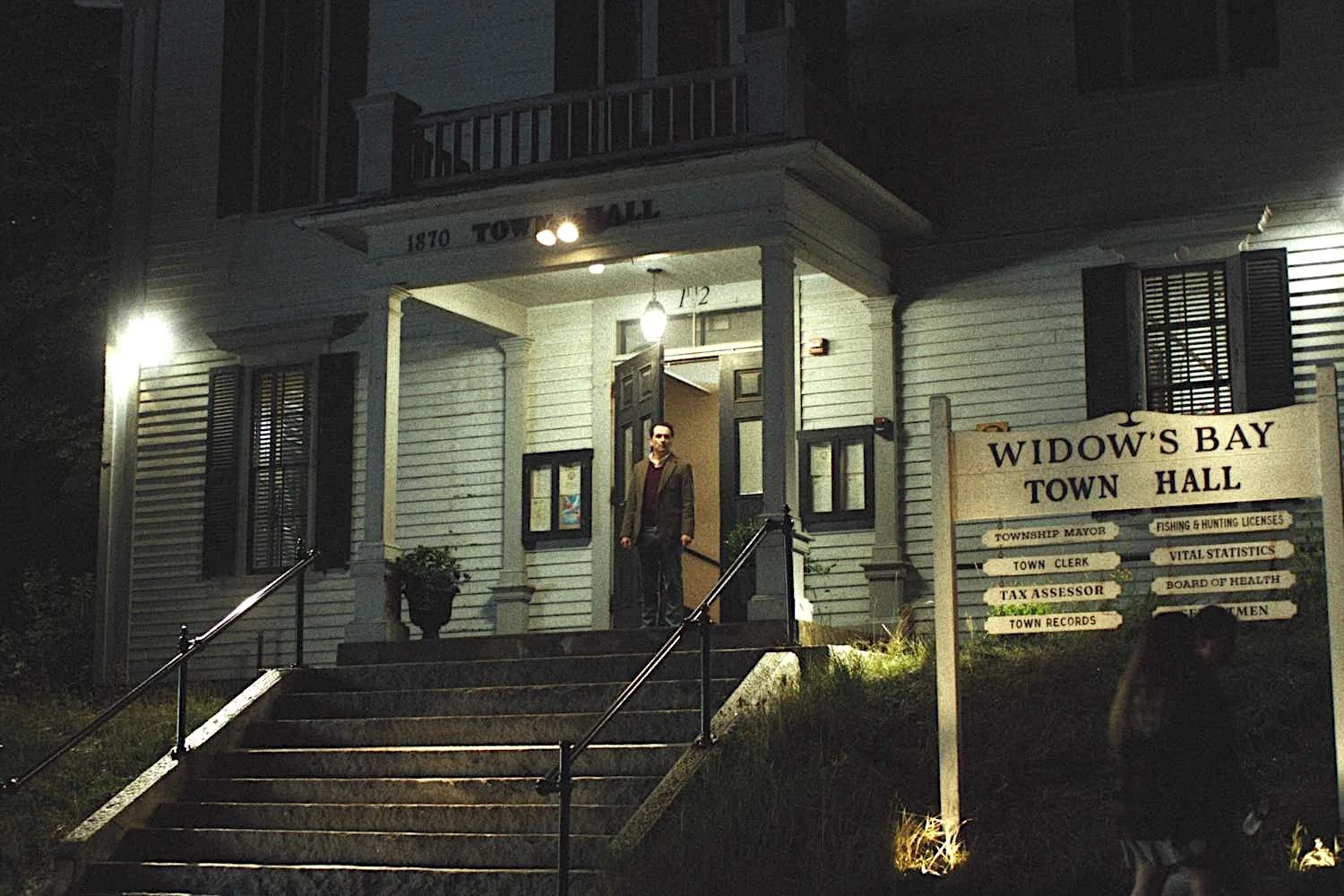
For instance, one of the main locations is the town hall. That’s where Tom’s office is, and it’s where he meets with a lot of the other characters.
PATRICIA: The entire island is out
TOM: This is exactly why I wanted to use the 128 credits. Did anyone talk to Mitch?
PATRICIA: Rosemary says he’s not in yet but she’s trying him at home.
TOM: Does anyone on this island work?
One of the clever things about the show is that the technology on the island is about 20 to 30 years out of date, and all of that retro tech gives the town an uncanny feeling.
STEVE: Katie had been very specific about the fact that we're not doing cell phones at all, uh, in this show because we just wanted to say that the technology was not there. So, we mixed things. There are old school typewriters. There was a lot of discussion about what kind of computers, how old would they, would they be?
Steve actually came up with a full backstory for the town hall in terms of when it was built, when it got remodeled, and when the technology was purchased. It’s also important for him to know the history of the building because it’s full of secrets and hidden layers that the characters discover over time. But the first challenge for Steve was to find a real building they could use for the exterior scenes.
STEVE: Because the town hall was going to be kind of a central important place that we return to, I looked and looked and looked, and there's this town hall is in a, in a little town called Berlin, little west of Boston. And that town hall in particular was built in the 1800s. So, what I did was I designed something that matched the exterior in terms of the windows and the fact that there would be double doors, you know, all that kind of stuff. I looked at it as if this building had been remodeled in the forties or the fifties, and they had come in and put in wood paneling, and that is of, of the fifties style. We did the Armstrong Tile floor, the checkerboard floor, which was very popular in those days. We managed to find some really wonderful fifties and forties, fifties fluorescent light fixtures that we put in. Then I picked colors as kind of a municipal gray, green thing that you used to see in a lot of municipal buildings. I knew that I didn't want to do, you know, the very bright, colorful, saturated world that comedies inhabit. I wanted to do something that was desaturated in some ways to push it into a historical context in a way that faded kind of patina that you get with, with something old.
One of the things that’s really fascinating to me is the different ways you evoke specific movies in the show. Obviously the most famous horror movie set on the Cape or the Cape and the Islands is Jaws. And you, you, could you talk about how you looked at that movie for very specific visual inspiration or even have visual nods towards it?
STEVE: So, what we found out very early was that one of Katie's favorite movies was Jaws. That's supposed to be on an island, it's a seaside village kind of thing.
CLIP: JAWS LOCALS OVERLAPPING DIALOGUE
STEVE: There's the town hall scene where they're walking down the corridor and they go into the conference room. So we copied things from all those, uh, frames, like the little, uh, things on the wall in the Con conference room in Jaws. It looks like they're little framed memos or some kind of letters or something like that. So we, we did that. It, the walls are very barren except for these little framed letters or, uh, some kind of document in the corridor. I noticed in Jaws, they walk through the corridor and these little signs that stick out that indicate the various offices, he hits his head on one of those signs and it kind of swings So, we copied that exactly. I mean, we got frames from the movie and copied the lettering style and the type of little sticking out sign holder thing. All of that we copied, as a fun element.
Another important element in Jaws is the boat owned by a fisherman and shark hunter named Quint. In Widow’s Bay, the character of Wyck and his boat play a similar role.
WYCK: So, we'll stop two minutes before we get to this line. That's the dead zone crossing. It will trigger this light. Beyond this buoy, people like me don't tend to come back.
STEVE: We copied the inside of the boat from Jaws and, uh, the wood paneling, the banquette, the little hanging light above the table in Tom's kitchen at his house. The light that hangs over the table is a copy of the one from Jaws, the drapery fabric. We tried to copy that as much as possible. The kitchen has other elements that are reminiscent of some of the elements in Jaws.
Whenever I see an article of all the hidden references in a movie or show, they’re usually not that hidden -- like I could imagine if a character in Widow’s Bay had mentioned the name of the island in Jaws, or if one of the characters had referenced the famous line from Jaws, “you’re going to need a bigger boat.” But that doesn’t happen. Instead, we get framed memos in a hallway, curtains in the kitchen, a light fixture on a boat. Who is going to notice that?
I think you still feel it on a deeper level. In fact, once I got past the surface level similarities to Jaws and I was deep into the storyline of Widow’s Bay, which is actually very different, I could still feel the presence of Jaws even if I couldn’t explain why. And that’s not the only horror movie Steve references in the production design.
AD BREAK
The premise of a demonic curse on the island gives the show a lot of flexibility because the curse can embody different horror movies and genres. Some of the episodes pay homage to Halloween, Carrie, The Wicker Man, John Carpenter’s The Fog, and one of my favorite episodes is reminiscent of The Shining.
The hotel in Widow’s Bay is supposedly haunted. Tom – the mayor -- doesn’t believe it. So, the locals at the pub dare him to spend the night there.
TOM: Okay, I'll do it. If that's what it takes. I will stay there tonight.
LOCAL: You have to stay in the Captain Suite.
TOM: The what?
LOCAL: Lost His mind. Got his family with an ax.
TOM: Of course, we then named a suite after him. Anything else?
LOCAL: The Ungrateful Hortence Fitzgerald.
TOM: Was she the lady who fell out a window?
LOCAL: Ugly woman who fled her wedding back through window and fell her death. If you see ugly Hortense three times, you'll see her ungrateful reflection.
Steve had a lot of fun designing the hotel. The exterior shot is a real building, although they added a tower in post-production to make it look like the house in Psycho.
For the interior, Steve used practical effects at one point to create a sense of warped perspective when Tom is feeling scared. He also looked at the wallpaper in The Shining for inspiration.
STEVE: We printed all that wallpaper in the, uh, lobby and then the parlor and the corridor, and the Captain Suite because I wanted to not only give it a particular Victorian feel, but I wanted to be able to control the color very carefully, the palette. So, the parlor is a little warmer and more, you know, inviting and the check-in desk and the corridors and things like that are a little cooler. Uh, we managed to find a whole bunch of really interesting artwork for the parlor and the entryway there. There's some sort of sad children pictures, you know, and things like that are, they're just kind of weird.
Well, it's funny, I think that if there's ever such a thing as a prop that's a breakout hit, it's those creepy board games that Tom finds. And I know you've been asked about them a lot. You work with a graphic designer named Ellen Lampel. Yeah. Um, what were some of the back and forth conversations where maybe she showed you some concept art and you said, this is great, or more like this? Like, what were those conversations like?
STEVE: Ellen and I have worked together. We've known each other for more than 20 years, and she is just so brilliant and has such a, a stalk of, of imagery in her head. And she would just start sending things because she was working remotely for us, and she would just start sending things. And I would, you know, maybe make a few choices, uh, give some comments.
SFX: TOM OPENING BOARD GAME
One of the board games that Tom finds is called Daddy’s Home. The box cover has a typical 1950s family, but daddy looks like he’s about to go into a murderous rage.
STEVE: The cover or the box has a picture of daddy and the kids just sitting around the table and mom and all of that. So, to get his expression on his face being really angry and frustrated and at the end of his rope kind of thing, that took a lot of tweaking with, okay, the eyebrows need to be a little bit more slanted and darker and bigger and, you know, the eyes got to be wider and maybe they're a little more bloodshot and all the, you know, kind of detail things going on.
There’s also a game called Teeth. That’s the title on the box: Teeth.
STEVE: Ellen sent all of these different old imagery of, of teeth, like sets of dentures, you know, that were from a catalog in the turn of the century in the 19 hundreds or whatever, and just all kinds of his teeth are missing and, you know, various, uh, versions. But then she came up with that single tooth. It was a happy, fun little guy as a tooth, but then you open the box and it's pliers <laugh> and it's just such a dissonance there that it really sells a joke and a scare at the same time.
But the treasure trove of funny props in The Historical Society.
In the first episode, a New York Times reporter shows up to write a story about the island for the Travel Section. Tom is thrilled, but he panics when he realizes the reporter has gone into the Historical Society and is meeting with the curator.
GERRIE: You know what, I was just about to show, uh, Arthur, the, the, the witch trial, uh, great source of pride. We caught 'em, we burned them.
TOM: You know what, you, you know what, Gerrie? I'm going to take it from here.
Steve says many of the props were described in the script, although he had a lot of leeway -- like he put in a mannequin wearing a straight jacket which is never explained. And he said there was a lot of experimentation as well because if a joke is too subtle, the audience wouldn’t get it and if it was too obvious and silly, the tension might be broken.
STEVE: We tried a whole bunch of different things. Some of them were a little bit corny, I would have to say. So, I wanted to have, and you don't actually see it because I think we decided it really didn't work, but we had an old carriage in there. Then I found out that we had access to a fake horse, and so we put the fake horse in front of the carriage, and it turned out to not really work the way I had thought it might work. So get rid of the horse. We're not really going to use the carriage very much. But then bringing other elements in and okay, these, these are costumes from the witches. Let's have more blood. No, even more blood. You know, a lot of the graphic work on the walls was very specifically described in the, in the script, but some of the other elements were not. So, we were just kind of playing with things as, as much as we could.
Yeah, I think that the closest thing to a joke is when the reporter asks about cannibalism and Tom says, no, what are you talking about, and then he points to this thing in the wall from the 1700s. It says, Cannibalism in God's house. <laugh>.
ARTHUR: Folks inside the church, they immediately turn to cannibalism.
TOM: I, I don't, I don't think that's right.
ARTHUR: I mean, it's sort of framed article inside The Historical Society.
TOM: Yeah. You know, these stories get so exaggerated over time. <laugh>
Well, tell me about the historical paintings too in the background, because they are so bizarre and hilarious and there's a lot of comedy and horror mixed in those, who came up with those and what were the conversations like around them?
STEVE: So that was all scripted by Katie and we had a wonderful portrait artist. And so, I would go over and we, I would discuss, okay, we've got to have them paddling away in this, in this rowboat, but this little girl has fallen out of the boat and what's keeping her afloat? Is it a piece of luggage that they took with them? And then Katie was just adamant, well, we have to have someone reaching out with this oar to, uh, save her. We kept scratching her heads, how is that going to work? That that, you know, a painting, a classical old-style painting would not have, basically you’re breaking the fourth wall with somebody reaching in. But it worked. And the one that probably took the most, uh, back and forth thing was the painting that Tom rips off the wall. Here's this young bride and this old guy, and he's kind of got his arm or, or hand around her neck and she's looking scared, but not too scared and not too freaked out. And that took many back and forth to get, you know, to get to that point of what we finally ended up with.
So, there's also clearly a, a Stephen King, uh, influence on the show. And you worked on Castle Rock, which was a show that was like, took place at a Stephen King-ish universe.
STEVE: Yes.
So, in terms of product, visual production, design, what conveys Stephen King?
STEVE: I, I think the New England setting has a lot to do with it, and Stephen King's books are, are extremely rich with layers and, and layers of detail and being in Massachusetts was extremely helpful. You get that underlying, the Salem witch thing, you know, the seagoing fishermen, old world quality. And there's something about that in Stephen King's world that I think is very subconscious, but it's there.
Yeah. One thing I also love about the show is that the characters don't reference movies or TV shows, but there actually is, at one point we see a book, with a Stephen King book, and I, whose choice was it to actually reference -- I think that's the only horror pop culture that gets specifically referenced. So I was curious about that.
STEVE: That was Jennifer, our, our decorator. She wanted to get that in. And I think you might not have caught it, but I think that there were some very specific things in the bookmobile also. And sometimes we put things into sets they may get seen, they may not. Uh, I was extremely happy that we focused, uh, as much attention on the games in the parlor because a lot of times, we'll go to a lot of, uh, trouble to make something very specific and it might not really make it in the cut or, or something for whatever reason.
Steve told me that one of his favorite episodes to work on was a flashback episode that took place in the early 1700s. It’s basically Puritan horror – which made me very happy. I’ve talked before on the show about my fascination with Salem, and they filmed those scenes close to the real location of the Salem witch trials.
STEVE: We looked at existing towns, you know, period towns that are historic museum locations and some of the ones that were closer to the coast, they wouldn't let us shoot there for whatever reason. And so, we had built some, a bunch of structures, uh, for the location where the ferry landing is and, and the statue of Richard Warren and all of that. And so, we ended up revamping all those structures and moving them to this place called Rebecca Nurse Farm, which had a great meeting hall and a couple of other buildings and they were the right time period, so we just made our own little village and our own little graveyard, bring in livestock, animals, things like that, and really have complete control of it. That made shooting there much easier.
Yeah. You also nailed, uh, well, literally in terms of hammering and nailing, but the, uh, that colonial -- actually, it's almost leftover from medieval England.
STEVE: Yeah.
Uh, style architecture. But it, but also, it's interesting because it felt new, because they had obviously just built the town, but it didn't feel fake new.
STEVE: Yeah, no, we were very fortunate to find that, um, to find that location. It wasn't too far away and there was just a lot of empty space there that we could work with.
We are going to leave Widow’s Bay – congratulations, you survived. I want to shift to talk about another surprise breakout hit this summer: the movie Backrooms.
Backrooms is a horror film which shares a lot of the same themes as Widow’s Bay. They both create a strong sense of place using practical effects. And they have overlapping themes around community, isolation, technology, and what gets lost in the pursuit of progress.
AD BREAK
In 2022, we did an episode called, “Monsters in the Static: Why Analog Horror Scares Gen Z.”
Analog horror has the aesthetic of older forms of technology. A common trope is found footage of old VHS tapes that reveal something scary.
And in our 2022 episode, we talked about a series of short films on YouTube called The Backrooms. They were made by Kane Parsons, who called himself Kane Pixels at the time. He was also in high school when he made these films. They’re supposed to be found footage from the 1990s, where a character has found himself in a maze of spooky, empty offices -- and something sinister is chasing him.
CLIP: “Hello?” SFX MONSTER CHASE
I assumed The Backrooms would stay in the world of Internet subcultures. But after we did an episode, Kane Parsons signed on to direct a feature length movie version of Backrooms. It came out at the end of May, hit number one at the box office, and so far, it’s earned almost $400 million worldwide.
The movie takes place in the early ‘90s. Chiwetel Ejiofor plays Clark, the owner of a pirate-themed furniture store. Clark discovers the Backrooms by accident and then he brings in his employees.
CLIP: Alright? You filming? Yeah. Follow my lead, Clark. What is this? That's what I'm trying to figure out. I’ve been here every night since I found the place, and I still barely scratched the surface. Just take it slow.
Our episode from 2022 featured Diane Rodgers. She’s an expert on digital folklore and she teaches at Sheffield Hallam University in the UK. I was curious what she thought of the Backrooms movie. So, I talked with her for our Patreon show, Between Imaginary Worlds. The full-length version of conversation is on Patreon, but I want to play a section of it for you now.
Diane told me that she was happy the director, Kane Parsons, was committed to using practical effects in the movie. And by the way, Kane Parsons just turned 21, so he grew up in the era of digital effects.
DIANE: You can almost feel the wallpaper and, and, and the carpet in the, I mean, everybody I'm guessing is familiar with those kinds of spaces. I was thinking about this actually, you know, like places like department stores, are they dying out now? I mean, certainly the ones in my city are, there are fewer and fewer of those spaces. So I guess, I know there's a lot of nostalgia from millennials and, and Gen Z, but our, our department stores becoming this alien space now and these unexplored, these empty buildings because of online shopping and the, the whole capitalism has changed how we shop. And those, those physical spaces are somewhat becoming somewhat alien to younger people maybe. So, they kind of want to explore these, what are these empty buildings in our cities? What are they like inside? What's in what's living inside there or under there? Or lots of imagined questions I think about those kinds of spaces.
any movie about the past is going to be really about the present.
DIANE: Absolutely. Yeah.
So, this movie that is set in 1990, how, how is it actually, what is it saying therefore about 2026, do you think?
DIANE: There are a couple of different things. I think partly, like you say, it's, there are a lot of, there's a big fascination with just pre-smartphone culture and a time where the Internet existed maybe, and certainly people didn’t seem to be obsessed with VHS and physical media. So people were still kind of becoming connected, but nowhere near weren't glued to screens and phones. And it was very much still about physical, tangible objects. These spaces in, in, in Backrooms particularly, or those kind of ideas is very isolationist. It's still very cut off from things. So, and, and today we have this para, I guess young people particularly have this paradox of you are constantly connected with your friends and everything and everyone, but you are also probably more alone than people have, have been because you are in, at, at home on your own. You're not necessarily socializing in person. So I guess these kinds of, what people often speak of about, describe as liminal spaces are between spaces. They're, they're not necessarily a destination in themselves. It's somewhere between one place and another.
In our 2022 episode, we talked about liminal spaces. The term is often used to describe spaces in transition. It could be a commercial space that’s empty, whether it’s closed for the night or scheduled for demolition. During the pandemic, a lot of buildings had become liminal spaces. But until Diane mentioned virtual interactions, I didn’t realize that they’re also liminal spaces because you’re alone and not alone at the same time.
It reminds me of another surprise hit this year. The Amazing Digital Circus is a computer animated series that began on YouTube. It’s about people who get trapped in a virtual world and can’t figure out how to leave. On the surface, the world looks cartoony and fun, but the storylines quickly turn to existential horror. And there are scenes of liminal spaces that look exactly like the Backrooms
The final two episodes of The Amazing Digital Circus were screened in movie theaters, and that night, it hit number one at the box office. It even beat Backrooms and a horror film called Obsession, which was directed by another filmmaker who got their start on YouTube. Diane says this is not a fluke.
DIANE: Yeah, because young people or the, the, the media that's available to people now is short form video, whether it's animation or shooting it, is so common. It's more common and probably gets a lot more interest and a lot more watches than long movies. And you can just make your own stuff and rebel against the big industries and um, AI as well to an extent. And you can just make your own stuff, get it on YouTube, get it on Instagram or whatever platforms people are using. You, you can use those platforms. It's equitable. Anybody can access it. Anybody can make their stuff. And it's all, I think the industry's probably worried because who really needs the industry? I see it as another moment where the, the, it's a real kind of shift in culture. Yeah, I think that they're running scared a little bit the big, the big studios.
Yeah. Yeah, yeah. I mean I think that's been their collective panic to some degree. Because also too, there's a sense of, for all of history, until recently they relied on young people who are bored and have nothing to do on weekends to go to movies. And the only question was which movie would they see? The idea that, sure, I'll go to a movie if I want to, but you know, I'm perfectly happy watching YouTube, social media, video games, whatever, that completely freaks them out. So, when they, young people do come in big numbers to movies, they're like, oh my God, oh my God, maybe we can tap into this.
DIANE: Yeah. And the, the fact that they didn't see that coming, that, uh, we, we didn't expect all these people to come to this. How did they know? But it's not anything we've done, like they've told it, it's been word of mouth. It's been like a, almost like a folk culture community around something that's happened, word of mouth that's happened completely without the industry doing anything. And they don't know, what do we do with this because we didn't make that happen. So how do we make it happen again? You can't.
And if they try, it has a stink to it, you know, because you're right. It comes, there's a, there's a sense of a folk, a digital folk culture.
DIANE: Yeah. It's inauthentic if it's forced. Yeah, absolutely. And, and that's what folk culture and folk communities are. It's about authenticity and something, something that's yours. They've got those kind of audiences, those communities, they've got ownership over it. This Backrooms thing that we've been following ours, and we are going to go and explore that. And my son is kind of 17, almost 18, and he rarely wants to go out to the cinema, but he watches all sorts of stuff across all sorts of platforms, and he would much rather do that. So, it's going to take something special to get people of his generation out to the movies and yeah, kind of capturing lightning in a bottle. I think <laugh>
So, what, uh, like what else are you excited about right now? You know, like three years ago, Backrooms was something that, you know, I only had heard of because I did research into this. It was up and coming. What are you excited about now that in, in the world of digital culture and online folklore that has been happening?
DIANE: I've just been talking to some people this morning about the fact that, um, there's a real, it's never gone away, but there's a really particular revival of interest in folk culture, um, in the UK particularly. So, things like Morris dancing, um, the Padstow hobby horse.
I don't know what any of this is, Morris dancing and what could you explain what that is?
DIANE: <laugh> These are very tiny, localized events that happen around the UK. So, there's, um, in Gloucestershire, there's a, like they have cheese rolling, people throw themselves down a hill once a year. Uh, and whoever catches the cheese gets to keep it. The traditions that have been going on for literally hundreds and hundreds of years, I could name lots of different ones and they're all a bit weird. There's one near me, um, in a town, very small village called Castleton, called Castleton Garland Day. Basically if, if you are unfamiliar with these kinds of things, but you have heard of the Wicker Man, they would all remind you of strange traditions that look a bit like they could be taking part in the Wicker Man. But there aren't sinister connotations behind these customs and traditions. But there's a revival of interest in these kinds of things and a revival of interest online, particularly. There are lots of online communities, particularly with young people building up around all these things. So, there's, there's kind of TikTok communities around hashtags like PaganTok and WitchTok and things like that. People sharing practices of, um, how to do spells or there are groups called, there's a group called Weird Walk and there's a group called Stone Club and there's another group called the Folk Union. And these are all online communities built around quite traditional folklore, but kind of reinventing it for, uh, younger generations. And so it's something, I mean, you know, because we're surrounded by literally thousands of, of years of history and stone circles and that are three, four thousand years old and in this country. And there's a, a really interesting engagement with that kind of culture.
It was reminding me a little bit, I mean, when I've read the early 20th century, there's this renewed interest in paganism and fairies and that kind of ancient culture. And it's probably not a coincidence. It was a time of huge technological progress. So, I wonder whether that's something that kind of sometimes happens and some people want to escape the modern world, and there's something that feels kind of mysterious and cleansing about these sorts of, you know, the beliefs of our, of our ancestors or, you know, the, the traditions.
DIANE: Yeah, I mean we, we've been talking about, um, I think particularly what's been going on here in the last five years or so is post-Brexit, people are suddenly rethinking their identity. And okay, if we're not officially European anymore, what does it mean? What is being English? What is British? What is that? And people often look to their history and roots and folk culture kind of comes to the fore again, and there's a rise of the right wing going on here and there's been lots of fights and debates about flying the English flag, for example, has become kind of a symbol of right-wing nationalism. And there are a lot of digital communities building around that. And Folklore against Fascism is, is one that's kind of people are joining, and it’s all folklore, Eric! <laughs>
That’s it for this week, thank you for listening. Special thanks to Steve Arnold and Diane Rodgers. Diane has a new book coming out next year called WYRD TV: Folklore, Folk Horror and British Television. My assistant producer is Stephanie Billman.
As I mentioned, the full version of my interview with Diane is on our Patreon show, Between Imaginary Worlds. It’s a more casual chat show that’s only available to listeners who pledge on Patreon. Between Imaginary Worlds comes included with the ad-free version of the show that you can get on Patreon. You can also buy an ad-free subscription on Apple Podcasts.
If you donate to the show on Patreon, you’ll get access to a Dropbox account, which has the full-length interviews of every guest in every episode. And you also get Imaginary Worlds stickers, a mug or a t-shirt.
You can subscribe to the show’s newsletter at imaginary worlds podcast dot org.