
Episode 311
When sci-fi movies take a big swing in depicting futuristic fashion, sometimes they end up creating iconic outfits and other times they create fashion which looks laughably outdated in a few years. I’ve became fascinated by three fashion designers whose work took center stage in sci-fi films and transcended the films themselves. I talk with fashion historians and authors Raissa Bretaña and Thèresa Winge about the influence of Paco Rabanne on Barbarella, the work of Jean-Paul Gaultier on The Fifth Element and the way Alexander McQueen was influenced by dystopian sci-fi, which informed the McQueen style in The Hunger Games: Catching Fire. Each of these collaborations left a lasting impact on cinema and fashion, from the runway to the shopping mall. Thèresa's book Fashion Adventures in Science Fiction Cinema comes out in December.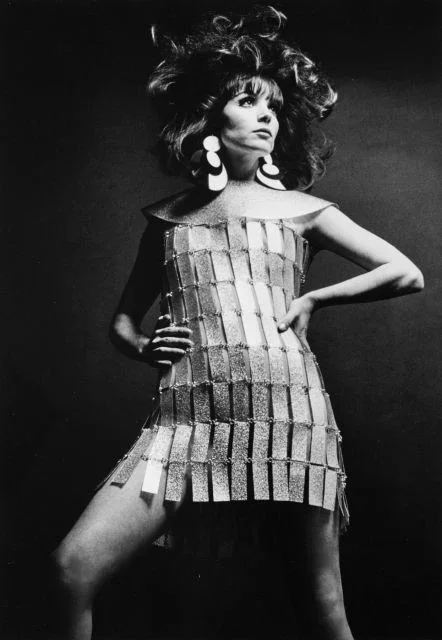
This episode is sponsored by Quince. Download the Quince app for app-exclusive offers or go to Quince.com/imaginary.MUSIC LISTGaze in The Mirror by The Fly Guy FiveTalens Bal by Blue Dot SessionsPxl Htra by Blue Dot SessionsVik Fence Haflak by Blue Dot SessionsSilence Breach by Sanctus
Sci-Fi Walks the Runway transcriptYou’re listening to Imaginary Worlds, a show about how we create them and why we suspend our disbelief. I’m Eric Molinsky.
I remember in 2019 people were posting pictures of Blade Runner and saying something like, “This is what we’ll all be wearing this year.” 2019 is the year Blade Runner took place. I saw similar memes in 2015 with Back to The Future Part II. That was the year Marty McFly traveled to and saw his future self wearing two neckties at once and a futuristic teenager were dressed like they were in a Mad Max roller derby.
I often joke that nothing dates faster than the future – or at least our visions of the future. But sometimes fashion in science fiction is so cool, people want to dress like that in the real world. The Matrix franchise inspired high-end fashion, streetwear and even sunglasses.
THERESA: A lot of fashion designers are fans of science fiction.
Theresa Winge is the author of Fashion Adventures in Science Fiction Cinema. Her book is coming out in December.
THERESA: Having worked in fashion, myself and I run an avant garde fashion program at Michigan State University, there is this lovely connection between fashion and science fiction where you're looking to the future.
I contacted Theresa because I was curious about her book. She told me about three legendary fashion designers whose work appeared in science fiction films. I found these examples so fascinating because each of these designers had been influenced by science fiction to begin with, and after their work appeared on screen, it changed what people wore in the real world.
I want to delve into these three stories one at a time.
TRAILER: Meet the most beautiful creature of the future.
Let’s begin in the year 40,000 AD – or 1968.
TRAILER: Her name is Barbarella, and she makes science fiction something else. Jane Fonda is Barbarella.
I had never seen Barbarella before I started working on this episode, but I had seen countless images of Jane Fonda looking incredible in those costumes.
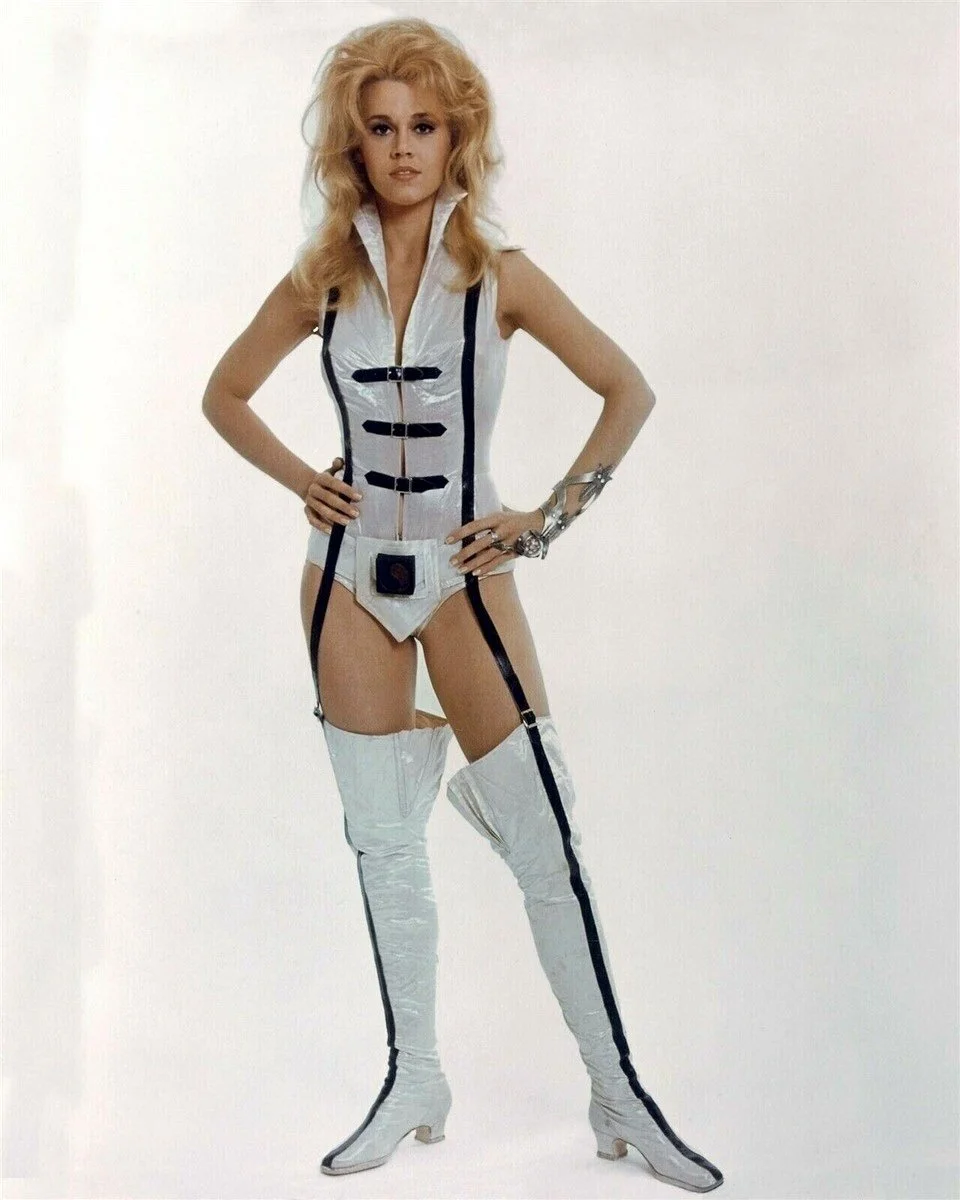
Each one is skin-tight, revealing her bare legs or arms. Some of the costumes have transparent plastic sections that reveal other parts of her body. And the materials on the costumes really shimmer. The director of Barbarella was her husband at the time, Roger Vadim, and the movie feels like a love letter to her.
I knew one other thing about Barbarella. That the villain had a very memorable name, or at least it stuck in the minds of a New Wave band in the UK.
PRESIDENT: Have you ever heard of a young scientist named Durand-Durand?
BARBARELLA: Yes.
PRESIDENT: Recently, while on a trip to the North Star, he vanished into the uncharted regions of Tau Ceti.
BARBARELLA: But why is that a secret?
PRESIDENT: Because Durand-Durand is the inventor of the positronic ray.
And he is hungry like the wolf.
By the way, that exposition doesn’t really matter. In fact, Barbarella is naked when she receives that intel. Right beforehand, she had slowly stripped out of her spacesuit while floating in zero gravity during the opening credits while groovy music played in the background.
THERESA: There's a real strong theme of sex running through the whole thing. Everybody is highly sexualized through their dress, through their appearance, through their actions. There's even an orgasmic machine that Barbarella gets trapped in and all of her clothes wind up getting pulled off of her and so on.
BARBARELLA: <squealing in pleasure>
Raissa Bretaña is a fashion historian and author.
RAISSA: I love Barbarella for many reasons, not the least of which is I worship Jane Fonda, but from a fashion perspective, I love Barbarella because it’s so clear what came before it and what came after it.
The costume designer on the film was Jacques Fonteray, but the fashion designer Paco Rabanne was a big inspiration for the overall look of Barbarella. Rabanne didn’t have a lot to do with the film, but his name and Barbarella were linked together for the rest of his life.
THERESA: It became twisted and convoluted over the years, everybody just assumed Paco Rabanne must have done everything. It is an easy thing to see how people got there, because so many of the costumes look like Paco Rabanne's fashions.
Raissa says, before Barbarella, Paco Rabanne was well known for collections that he called 12 Experimental Dresses and 12 Unwearable Dresses. His clothes looked so futuristic, he got the nickname, “the Jules Verne” of fashion. Although today she says we would call those dresses a classic example of space age design.
RAISSA: Space age design is really informed by clean lines and geometry. Usually there's also kind of futuristic looking materials incorporated -- so metallic materials, plastics, things that look like, you know, they're the fabrics of tomorrow.
Compared to the costumes in Barbarella, the shapes of those “unwearable” dresses are surprisingly modest and traditional. What’s groundbreaking is that the clothes were made of industrial materials like plastic discs and metal rings, that Theresa says were not considered appropriate for high-end fashion at the time.
THERESA: The fact that he really embraced these brand-new materials and textiles that most people weren't even aware of yet, that made his designs when they came down the runway truly look futuristic. And, uh, the ‘60s we're all about what's next, what's going to happen next? How is it going to look? The future's going to be very different than our past.
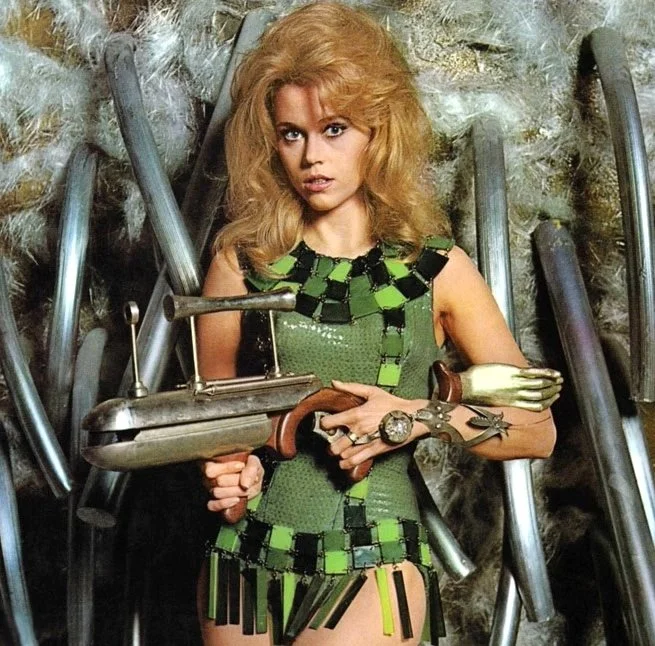
Paco Rabanne does get on-screen credit for inspiring the outfit Barbarella wears in the final sequence.
BARBARELLA: Emergency systems!
RAISSA: And it's a green scaly body suit that has small green, transparent squares, uh, embellishing the front, and then there are dangling pieces around the hips that kind of resemble a skirt.
And she says the film actually influenced the clothes Paco Rabanne designed after Barbarella.
RAISSA: And some of the more chain mail type garments that he makes later on do actually resemble some of the costumes in Barbarella.
THERESA: And so, all the materials that are used in that are these plastics vinyls that will eventually become, uh, very common to see in fashion, particularly in the eighties. We see it happen in the late ‘70s and through the ‘80s into the ‘90s as well. Then there's a revolt. People want natural fibers and whatever, and we move away from it.
So, Barbarella did turn out to be the fashion of the future, at least for a while. But Raissa says that look never really went away.
RAISSA: Like Ariana Grande's Break Free music video is like a love letter to Barbarella and the costumes and the, you know, zero gravity strip tease that she does. But she also referenced Barbarella in the marketing campaign for her beauty brand. One of my favorite editorials in recent years was for Interview Magazine. This was the Winter 2021 issue where Zendaya is styled by Law Roach, and each look is an homage to different costumes in Barbarella.
It's funny became I tend to think of that design as being so late ‘60s. Like it's sort of like the kind of thing where it's kind of retro, futuristic, like a much more daring version of the fashion on Star Trek, uh, the original series. So, so it's interesting to know that it, that it, it wasn't something that sort of had become really dated by let's say like 19, you know, 80 something.
RAISSA: No, on the contrary, I think that it feels very fresh and young right now, but also, I think there's a little wink that, you know, it says something about these artists that they're able to reference this campy movie from the ‘60s, but that element of camp, I actually think that camp rescues many films from obscurity.
But what, it's interesting though, what is it about, because I know what you're saying, it's true. Like why is it that when we look back the camp, the stuff that's really campy, weirdly transcends its time more than a lot of the other stuff that was supposed to have been taken more quote unquote seriously in its own time?
RAISSA: Maybe because it's more accessible, it requires a lower barrier of entry, but also, I think people just identify with it more. Uh, case in point, I will tell you a little narrative <laugh>. So, I taught a course at the Fashion Institute of Technology about costume and fashion and film, and I always looked forward to screening Barbarella. I loved to shock and amaze my students with this film. The class had been taught by other instructors before me, has since been taught by other instructors after me and the other instructors won't screen Barbarella, which I think is a crime.
I mean, why won't they screen it?
RAISSA: They think it's too ridiculous or it's demeaning or too unserious, but you cannot deny the fashion impact of that film, which is why I've become known on campus as like the girl that will make you watch Barbarella. <laughs>
Next, we’re going to look at another film that’s also campy, and like Barbarella, it did not get a lot of critical respect when it came out, but it had an influence on fashion that we can still see today.
AD BREAK
While researching Barbarella, I learned that the character originally came from French comic books. I already knew there is a long history of French comic books -- especially sci-fi comics. One of the reasons I wanted to learn French. A lot of those comics are not translated into English.
The director Luc Besson is also a fan. And for his 1997 film The Fifth Element, he hired two of my favorite French comic book artists, Moebius and Jean-Claude Mézières, to work on concept art for the film.
This movie is a visual and auditory feast. The plot is kind of beside the point. But for context, The Fifth Element takes place in the 23rd century. Milla Jovovich plays Leeloo. She’s a chosen one-type figure who is on the run from alien and human villains. She teams up with a cab driver played by Bruce Willis. Although she doesn’t really team up with him as much as jump out of a skyscraper and land on his flying car.
DALLAS: You might remember me from the cab. Remember? Bat a boom. Big bat of boom?
LEELOO: Boom?
DALLAS: Big bottom boom, in the cab here. Look like I drive a cab. This is me, Korben Dallas.
The costumes in the film were designed by Jean-Paul Gaultier. He is a legend in the fashion industry. He’s probably best known in the U.S. for designing cone-shaped bras, especially the ones worn by Madonna.
Now, the French comic book artists who did the concept art already had a strong sense of character design. So, I asked Raissa, where does she see Gaultier's influence on the film?
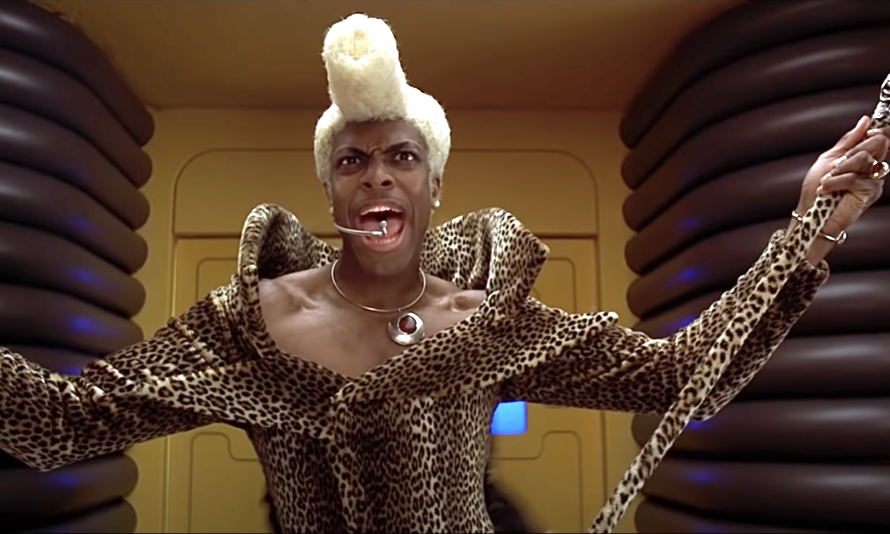
RAISSA: I think there are places where it is 1000% Gaultier and you definitely have to talk about the, I think, most memorable costume of the film, which is the very flamboyant leopard bodysuit worn by Chris Tucker as Ruby Rhod.
RUBY: Here he is -- the one and only winner of the Gemini Croquette contest. This boy is fueled like fire. So, start melting ladies 'cause the boy is hotter than hot. He's hot. Hot.
RAISSA: And that I think epitomizes Gaultier’s design sensibility because it's so subversive and overtly effeminate in a way that that feels, I don't know, almost transgressive.
Theresa says the real struggle Gaultier had on The Fifth Element was the budget.
THERESA: Fashion designers are used to using the best fabrics and it costs a lot of money to put together a fashion show, like millions of dollars for one fashion show And so, his biggest complaint about The Fifth Element was he had to design about a thousand outfits and that he couldn't buy the right materials, he couldn't get the funds that he wanted. He literally, there's one interview where he says he dipped into his own private design stock for materials because he wanted the look of the film to be cohesive
Gaultier came of age around the same time as Barbarella, and she says you can see that sensibility in the costumes.
THERESA: Jean Paul Gaultier is a fan of science fiction, but a lot of his influences for his fashions tend to come out of the queer community. Fifth Element allowed him to pull in things like his love of bright, highly dynamic contrasting colors, and he's constantly pushing silhouettes, particularly for male figures, but he loves all kinds of female body types and that is not something you commonly see in a fashion designer.
Interestingly, some of the most influential costumes in the film were not designed for main characters. At one point, Leeloo and Dallas go on a space shuttle that’s more like a luxury cruise liner in space.
FLIGHT ATTENDANT: Sweet dreams. Mr. Dallas.
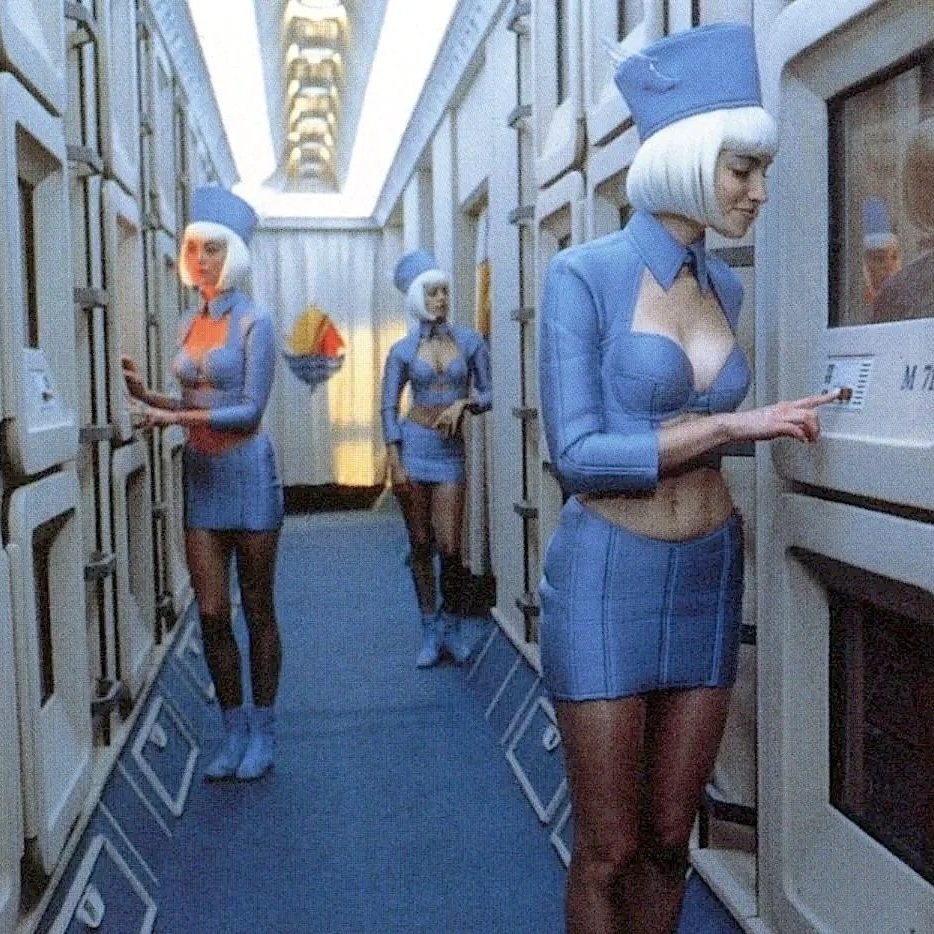
The flight attendants are wearing periwinkle blue uniforms that play with which areas of the costume reveal skin. The women are also wearing pillbox hats on top of white wigs in a bob cut.
THERSA: And the flight attendants’ uniforms are just lovely. They're really smartly designed and he had to fit them to those people very specifically. And that I can tell by the way that they can move in them and everything that, that each actress and these are not central characters, had special fittings to make sure that those outfits looked exactly as they should.
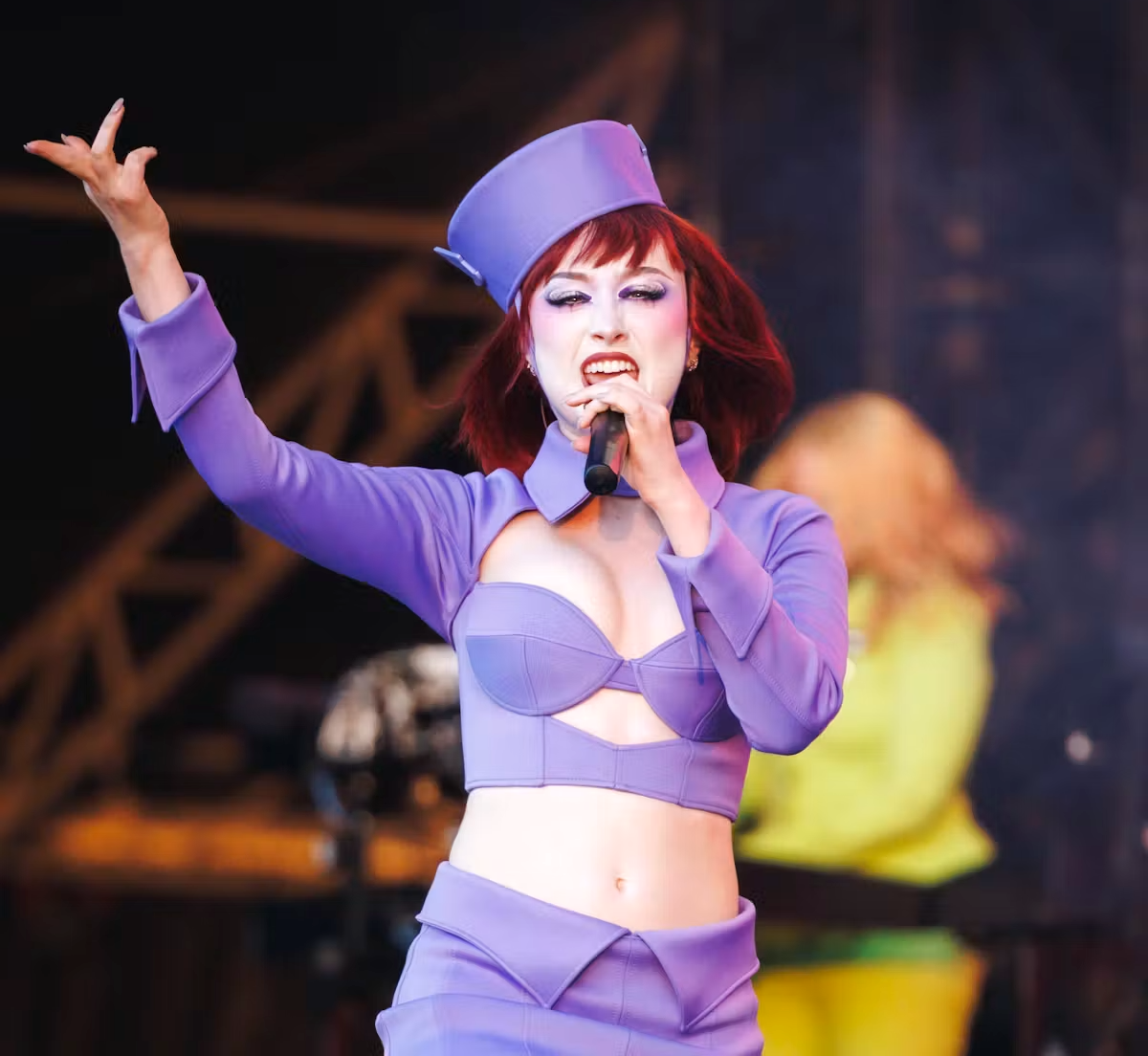
Now, this movie came out almost 30 years ago, but just this summer, Chappell Roan wore an outfit at a music festival that was an homage to those flight attendant uniforms. She wrote on Instagram that wearing the outfit helped her live out her Fifth Element fantasy.
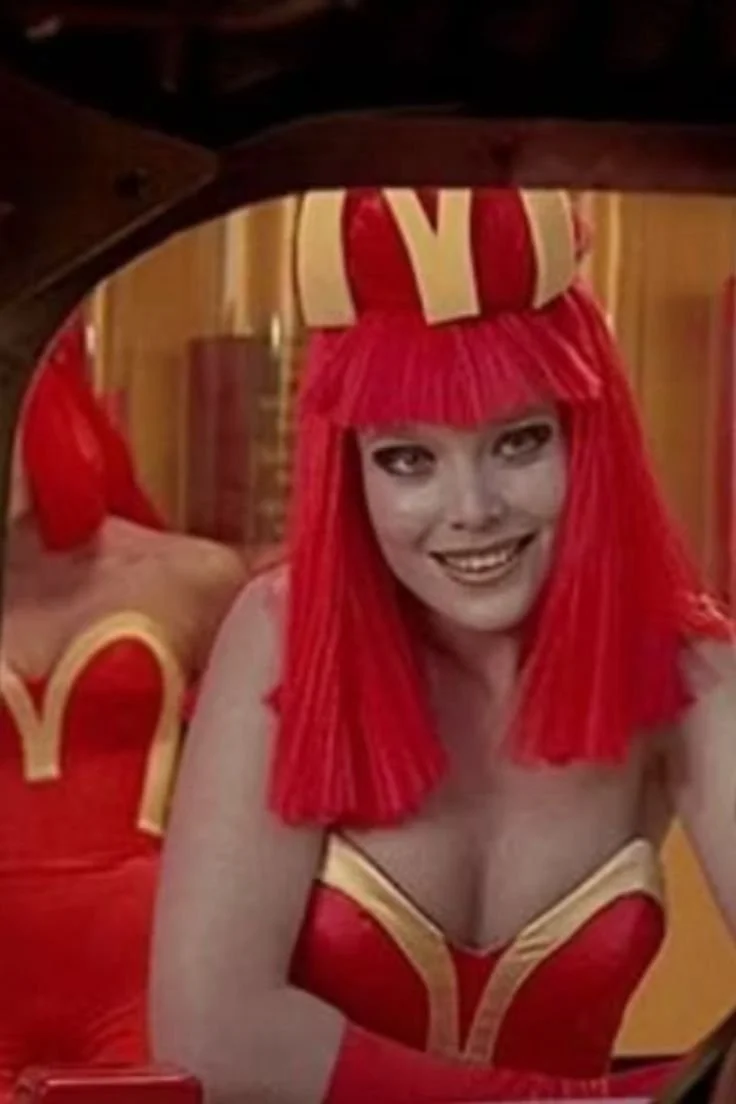
Another breakout hit were the costumes worn by futuristic McDonald’s employees. It’s a short scene when a flying police car floats by a drive-by widow.
MCDONALD’S GIRL: Two golden menus.
COP 2: Thank you.
COP 1: I'm too old, too tired to chase some hotrod.
Gaultier plays with the design of the golden arches on the women’s hats and bustiers, and they're all wearing red wigs in a bob cut.
THERESA: When you think about the McDonald's uniform and how little bit of time it takes up in the film, it's remarkable that it's had such an impact to influence, I would say about five or six fashion designers. Um, and I get it, like I, I saw those costumes in the movie theater, and my husband was staring to me, I go, oh my God, they're so gorgeous. And afterwards he's like, the McDonald's uniforms? <laugh>, And I was like, yes, yes, they were phenomenal.
Raissa says another designer who was influenced by that film is Jeremy Scott.
RAISSA: His Fall 2018 Ready to Wear collection was just a love letter to Fifth Element. And they were wearing kind of these Day-Glo knitwear ensembles that had metallic outerwear and the crisscrossing harnesses, and so, it's hard to look at the looks from that runway show and not think of Fifth Element. It's so obvious.
It's interesting to me that that like a show, a fashion show from 2018 is something like given I think of fashion as something that kind of, like the whole point is it goes in and out of style pretty quickly. That people would then look back at a fashion show a bit a certain designer show from a certain year, the way that other people may look back at a movie. What is the influence of something like that? Like when he does a show like that in 2018, you know, in 2026, what is the legacy of a show like that and why is it still something that, that you remember?
RAISSA: It's funny, I've never actually heard of a collection being compared to a film, but now that you're saying it, that is how this information lives in my head. And I think these legendary collections, the one that live on a lot of them exist outside of time. Like, I don't think there was anything particularly 2018 about that collection. But because it was referencing something that has now been considered a classic, then it's kind of able to stand alone, which is why I maybe think a lot of designers are really mining references these days. It gives their work a bit more longevity.
The fashion of The Fifth Element didn’t stay on the runway. Theresa saw their influence in shopping malls and big box stores.
THERESA: The tank that both Leeloo and Dallas wore, those showed up in virtually every store that sells t-shirts, that styles, sleeveless tank, ribbed, white, and they had crop version and a full-length version.
And Gaultier used a distinctively bright shade of orange on both Leeloo and Dallas’s costumes.
THERESA: I actually got an orange rubber bag that I think I bought at Target, and it was really reminiscent of, uh, the kind of, uh, orange braces that Leeloo wears, that kind of rubber, that kind of orange. We don't see orange in everyday fashion. And for that reason, it kind of stood out to me and I started kind of paying attention.
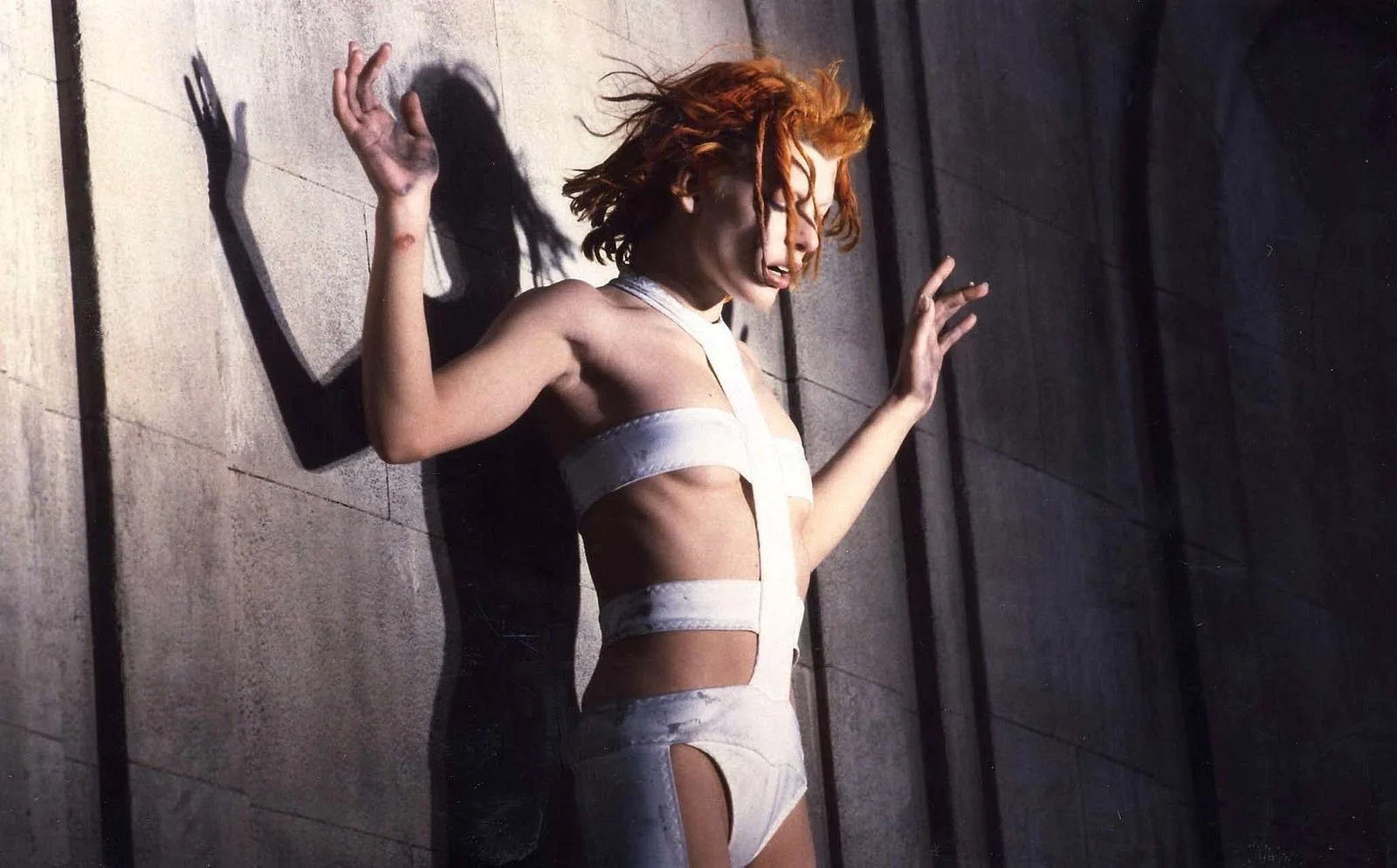
I have one more example from The Fifth Element: Leeloo’s bandage costume.
The character is an ancient being who is brought back to life with futuristic technology. At first, her newly generated body is naked. Then the machine wraps her in cross crossing white bandages.
COMPUTER: Thermal bandages. SFX
THERESA: Now, they could have done that in a lot of different ways. They could have covered her in a lot of different ways, but, uh, he didn't want The Bride from The Bride of Frankenstein, where it's a big billowy white cover for her. They wanted her to be sexy. They wanted to reveal some skin at the same time. They wanted this to look futuristic. And now there's something called a bandage dress, and that is these kinds of, um, spandex or Lycra strips. And they were quite popular right after the film came out for a few years, they went away and they came back for a little bit, and now they're not popular again.
Although the ‘90s are back – so who knows?
Next, we are going to the opposite end of the bright and campy spectrum. We’ll be dressing for a dystopian future, or a more dystopian future than the one we’re living in.
AD BREAK
One thing science fiction and fashion have in common is that they can take elements from different eras and remix them. If it’s done well, a fashion show or a work of science fiction should not feel like a pastiche. It can feel ahead of its time, or even timeless.
I can see the aesthetics of Barbarella echoed in the costumes of The Fifth Element. Both movies were made at a time when the zeitgeist was optimistic about the future.
Then you have the fashion designer Alexander McQueen. He grew up in the 1970s and ‘80 in a working class family on the East End of London. As a child, he was abused and witnessed abuse. He felt very drawn toward dark and dystopian films.
RAISSA: First and foremost, Alexander McQueen was hugely inspired by cinema. He actually named many of his collections after films that he was inspired by,
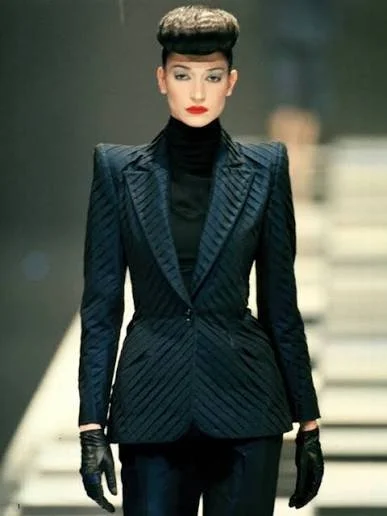
Some of the collections were inspired by horror films like The Birds, The Shining, Psycho and Scanners. And in 1998, he debuted a collection for Givenchy that was inspired by Blade Runner.
RAISSA: That collection is, is totally Blade Runner. I feel like every model looks like a version of Sean Young in that film, in those really sharply tailored suits, those 1940s bumper bangs. And it's clear that he is referencing Blade Runner, but it's also clear that Blade Runner is referencing Joan Crawford from the 1940s.
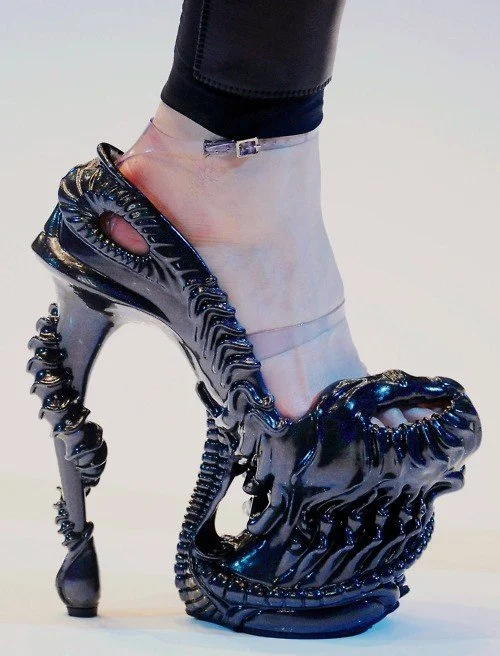
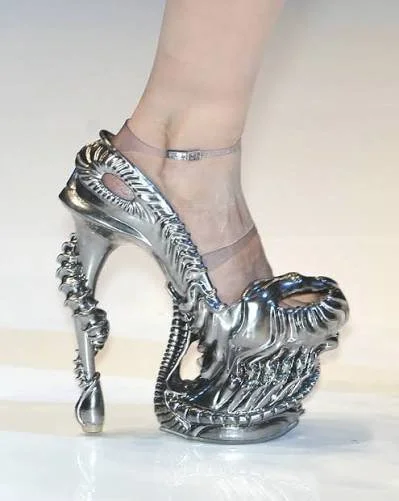
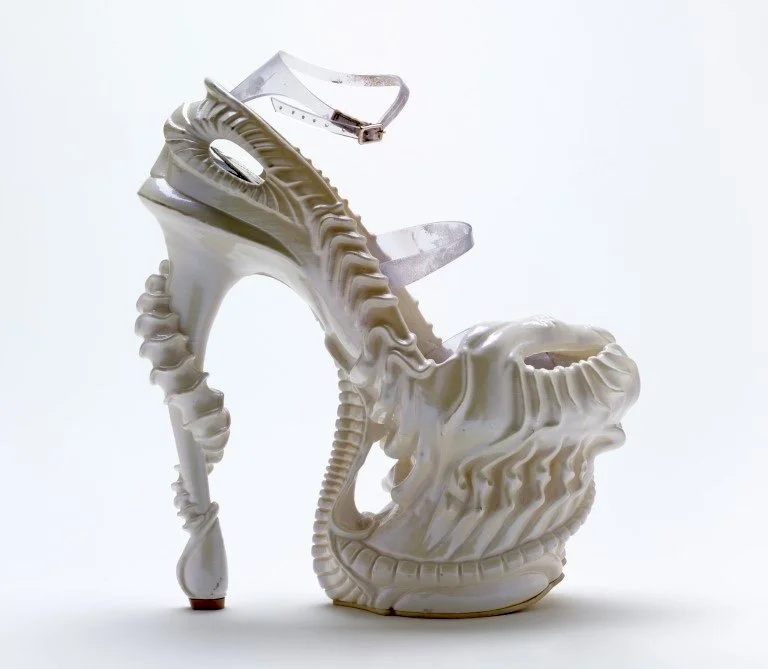
The movie Alien was also an influence on him. In his final collection before he died, McQueen debuted high heeled shoes that were inspired by the Xenomorph creature.
RAISSA: And there were 11 different versions of this shoe, and any museum would be very, very happy to have it in their collection.
Can you describe, became of course people know the Xenomorph from the Alien movies and they know what a shoe looks like, <laugh> So how could you describe what it looks like a Xenomorph shoe?
RAISSA: Well, the shoe itself was actually made from 3D printed resin. It looks almost as if it's been sculpted with kind of skeletal qualities. Uh, it does very much look like the alien from the film, but I think what's so cool about them is they're referencing kind of this very futuristic science fiction aesthetic, and it's executed through a very futuristic manner of production. So, it feels like a cool marriage between those two things.
Theresa thinks that’s similar to Paco Rabanne and his space age designs.
THERESA: But he also had a real eye for nature and would pull that in, and he would create snake textiles in his materials that then he would make a garment with.
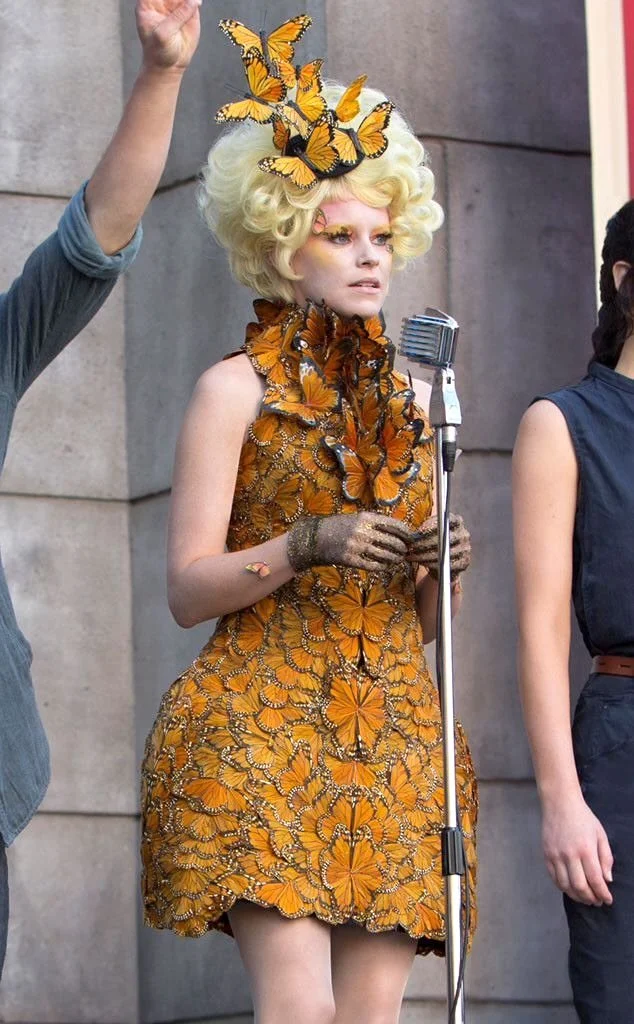
For example, in the second Hunger Games film Catching Fire, the costume designer Trish Summerville worked with The House of McQueen. At one point in the film, Elizabeth Banks’ character Effie wears an outfit called The Monarch Dress. The dress looks like it’s made out of hundreds of butterflies, but they’re not real butterflies .
EFFIE: Welcome, welcome. As we celebrate the 75th anniversary and third quarter Quell of the Hunger Games.
The Monarch Dress was not designed by McQueen himself. It was designed by Sarah Burton, who became the creative director of his design house after he died. But the work they do is aligned with his vision and sensibilities.
THERESA: And so, it has a silhouette that is very torso hugging with the corset, and then it's a fuller skirt that's really shaped. You cannot see Elizabeth Banks' body under this. She could be any size, she could be any shape. The dress really stands all by itself. It's so structured, and it was covered in soft materials that created the look of a monarch butterfly.
One of the big questions that science fiction explores is, what makes us human? The answer is often our bodies, but what a science fiction story has to say about our bodies depends on the storyteller.
Obviously, fashion is very focused on the body as well. And Raissa says, these designers were a perfect fit for science fiction because their styles were already considered futuristic.
RAISSA: In thinking about what makes us perceive any design as futuristic, I think it comes down to garments that make the human body into something that is inhuman. And I think these three designers do it in different ways. So, Paco Rabanne used these unconventional materials for his unwearable dresses, covered the body in metal plates, almost turning the body into a sort of machine. It's not a human shaped garment. The human is simply the hanger for the garment. I'd say Gaultier’s designs are much more body conscious, they're much more revealing. They do emphasize certain parts of the body. However, with all of the kind of boning and corseting, he's a rearranging the human body to create something that is idealized. And then on the other hand, you have a designer like Alexander McQueen who did these wildly fantastical designs. His work transformed women almost into these mythical creatures with his designs that featured things like antlers and feathers and shells, things gleaned from the natural world, but when taken together appear very creature-like.
She thinks there’s another reason why a lot of fashion designers are drawn towards science fiction.
RAISSA: Many of the sci-fi films, at least that I, I talked about in my course, many of them fantasize about what would be possible for fashion. I'm thinking of Forbidden Planet when, when she goes to the robot and she says, you know, I want this dress made of star sapphires and I need it tomorrow, and the robot says, you know, I'll, I'll just make that up for you.
ROBBY: I will run the dress up for you in time for breakfast. Sleep well, miss.
ALTAIRA: Thank you, Robby!
RAISSA: Or like, in Fifth Element with the, the nail polish changing.
SECRETARY: Zorg’s office.
RAISSA: Or something like Hunger Games where you have a dress that's transformed by fire.
SFX: KATNISS’ DRESS
RAISSA: Science fiction is a conduit to really advanced design.
There is a slideshow of the costumes we talked about on the Imaginary Worlds Instagram and Facebook pages. And if you’re curious to learn more about that movie she mentioned, Forbidden Planet, I did an episode about it in 2025.
That’s it for this week. Thank you for listening. Special thanks to Raissa Bretaña and Theresa Winge.
We have another show called Between Imaginary Worlds. It’s a more casual chat show that’s only available to listeners who pledge on Patreon. In the most recent episode, I talked with Charlie Claire Burgess. They are part of a new wave of artists who are reimagining Tarot Cards. We talked about how they depict the archetypal figures on the cards as nonbinary and dressed in contemporary fashion while still honoring the tradition of the major arcana.
Between Imaginary Worlds comes included with the ad-free version of the show that you can get on Patreon. You can also buy an ad-free subscription on Apple Podcasts.
If you donate to the show on Patreon, you’ll get access to a Dropbox account, which has the full-length interviews of every guest in every episode. You can also choose free Imaginary Worlds stickers, a mug or a t-shirt.
You can subscribe to the show’s newsletter at imaginary worlds podcast dot org.